

Catching Churn Risk and Growth Earlier: What We Heard in Our Staircase AI Deep Dive
- 0 replies
- 2 views
- Translate All
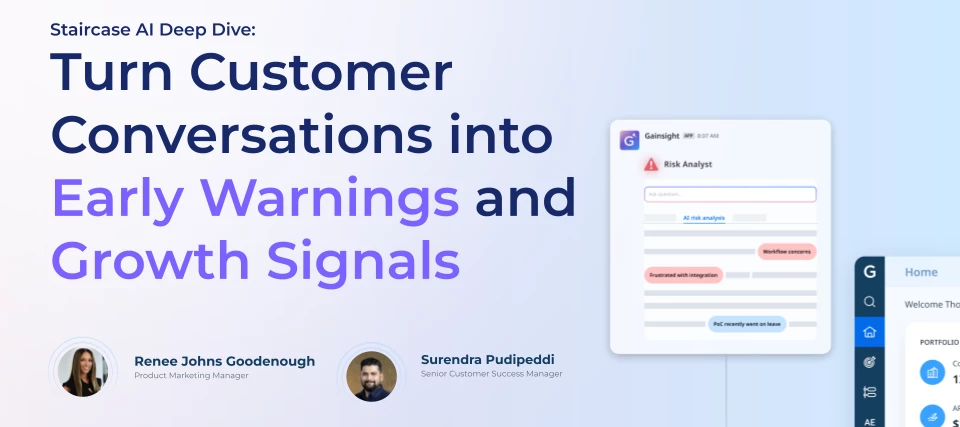
We had a great conversation in our recent Staircase AI Deep Dive with Surendra Pudipeddi, one of our senior customer success managers, about what it takes to catch churn risk and growth signals before they show up in the health score.
Surendra walked through three live demos, covering risk, expansion, and meeting prep, and we ran polls along the way so attendees could share where their teams get stuck. Your questions kept coming back to trust: how to tune what Staircase flags, correct a signal that’s off, and make sure the right emails land on the right account.
Through it all, one thing came through pretty clearly: the signals usually aren’t missing. They’re sitting in emails, calls, and tickets that no one has time to read.
A few things that stood out:
1. Health scores tell you what already happened. Conversations tell you what’s coming.
We kept coming back to a familiar pattern. A champion’s replies slow down, but the tone stays polite. A QBR gets skipped and nobody flags it. A ticket closes inside SLA while the customer’s frustration keeps building. Each one looks fine on its own, and the health score stays green.
When we asked what gets in the way of catching churn risk early, Signals are spread across too many tools led the way, followed by the team is stretched too thin to monitor every account.
The shift is less about adding another dashboard and more about getting the right signal in front of the right person while there’s still time to act. We walked through it in four steps: Identify, Alert, Review, and Act.
2. Growth hides in the same conversations
We shared a scenario: a customer opens a support ticket asking whether you integrate with a tool they’re adopting. What happens next? For a lot of teams, the ticket gets answered and closed, and the signal closes with it.
That’s where the Expansion Analyst comes in. It’s one of our pre-built agents, and it reviews the last 90 days of customer interactions, scores how ready an account is, explains why, and tags the type of opportunity: upsell, seat expansion, or new product. Not every signal is an opportunity, so the goal is to surface what’s worth investigating, with the evidence attached.
3. Meeting prep is a practical place to start
When we asked about the biggest pain in prepping for a customer meeting, piecing together context from multiple tools and missing an open issue until the customer raises it came out on top. Every one of those pains comes down to the same thing: the context is scattered.
Ask Staircase Starters are pre-built prompts for the moment you’re in, like Prep My Meeting before a strategic call, Risk Check before an escalation, and Renewal Prep before a renewal conversation. And with the MCP connector, you can bring that same context into Claude, ChatGPT, or Gemini.
If you’re thinking about where to start
Think about the last account that surprised you. Then ask:
- Where did the first signal show up: an email, a meeting, or a ticket?
- Who needed to know, and how quickly would they have heard?
- What would they have needed in front of them to act?
If you can answer those, you have the beginnings of a useful early warning workflow. From there, a couple good places to keep going:
- Try a Starter before your next customer call. Prep My Meeting is a good first one.
- Looking for ideas on what to ask your AI tools? Check out the MCP Prompt Library.
- Join Staircase AI Office Hours, Wednesdays at 11:00 AM ET.
- Want to see Staircase on your own accounts? Email customersuccess@gainsight.com.
A big thanks to Surendra and everyone who joined us and brought great questions to the session.
Want to see the full session? Watch the recording for the live demos, polls, and Q&A, and download the slides to keep the examples handy.