  • 487 Product updates

Gainsight CS Patch Release Update - September 30, 2026
Gainsight CC: More Sign-In Flexibility and Safer Image Uploads

Gainsight CC: More Sign-In Flexibility and Safer Image Uploads

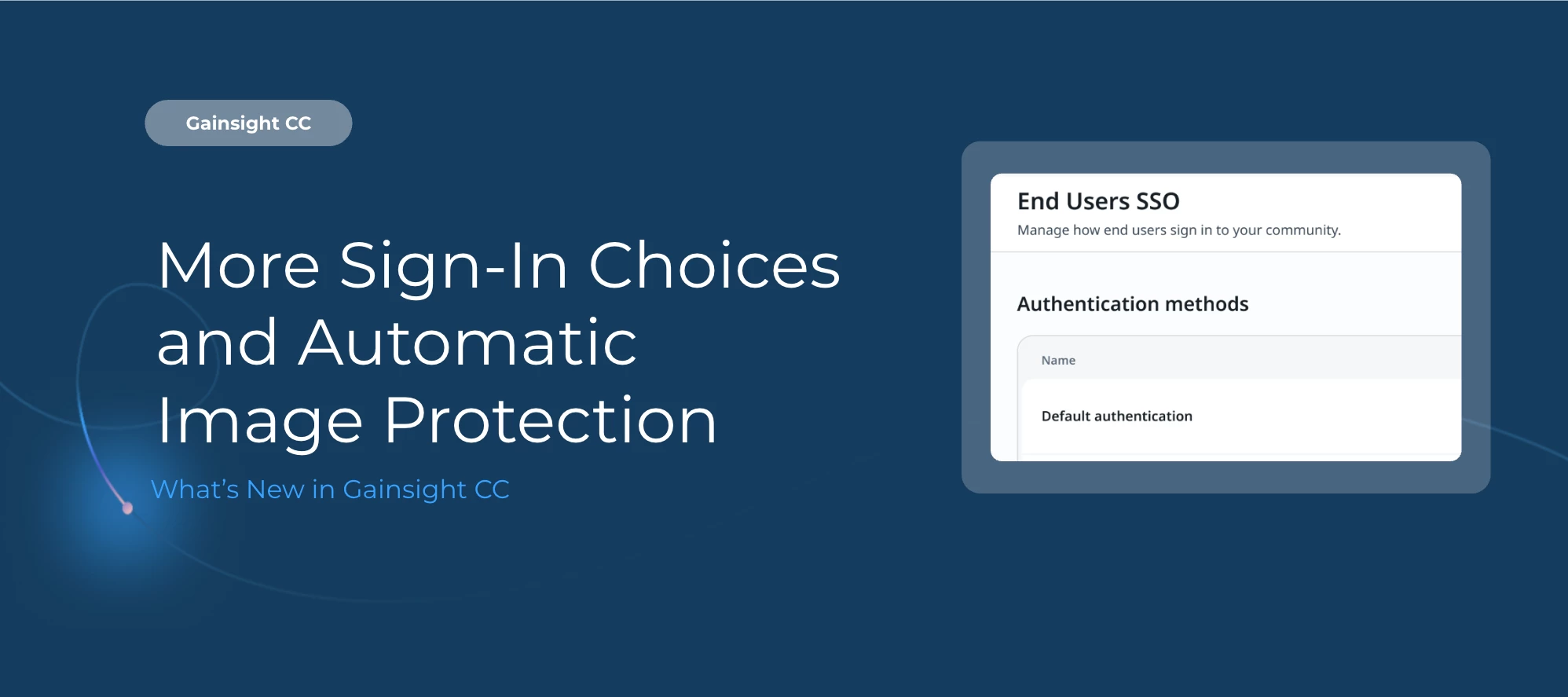
This release gives admins more control over how members sign in and adds an automatic layer of protection for every image uploaded to your community.Here's What's NewConfigure Multiple SSO Methods for End UsersAdmins can now configure more than one SSO method of the same protocol type, such as two separate OpenID Connect connections. This makes it easier to set up distinct sign-in paths, for example separate methods for employees, customers, and partners, even when those methods share a protocol.Protect Your Community with Automatic Image ModerationEvery image a member uploads is now automatically checked before it goes live. Images identified as harmful never appear in the community, and images that pass publish exactly as they do today, so there's no change to the upload experience for members or moderators. This check runs on every upload with nothing to configure. It applies to images uploaded after this enhancement is enabled for your community; previously published images aren't rescanned or removed retroactively.Getting Started Multiple SSO Methods: Configure in Control; see the Configure Multiple SSO Methods of the Same Protocol article Image Moderation: No action needed, this is on automatically 👉 Check out the Release Notes for more details.💬 Have a question for ​@marekkoszlak and ​@Sudhanshu? Drop a comment below!

Related products:CC ModerationCC Users & Roles
Gainsight CC: Deeper CS Sync, a New CLI, and More Preview Control

Gainsight CC: Deeper CS Sync, a New CLI, and More Preview Control

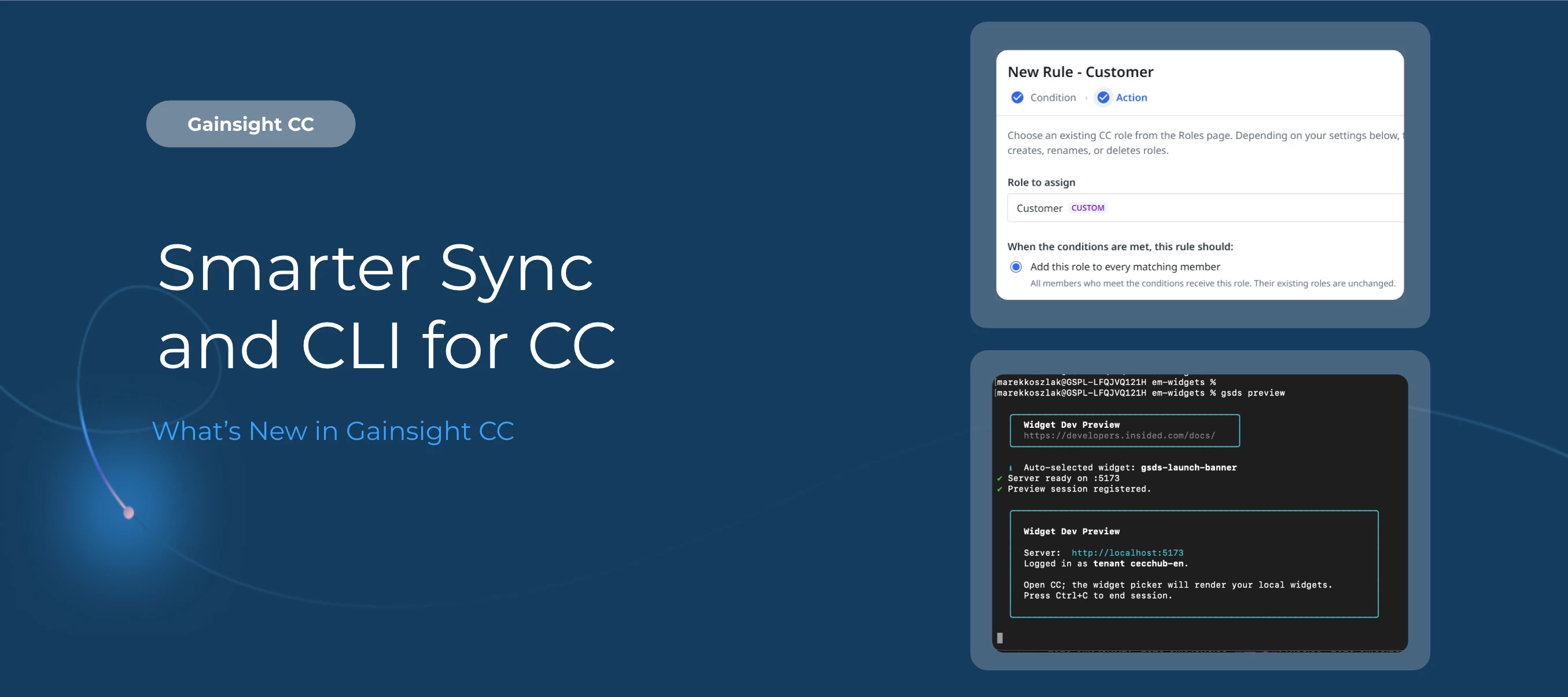
This release brings a mix of new capabilities and workflow improvements: automated role assignment from CS data, a local development environment for Developer Studio, category-level translations, and more. We're also introducing a new way for you to preview upcoming changes before they reach your members.Here's What's NewBuild and Preview Community Widgets Locally with the Developer Studio CLIThe Developer Studio CLI scaffolds the starting file structure for a new widget directly from your terminal, and pairs a local development environment with your live community instance. Widgets preview, served from a local server to the live instance with the same theme settings and branding, refreshing instantly whenever you save, and connectors can run against real data on your local machine, checking authentication, responses, and errors before anything reaches a hosted environment. Whether you test manually or hand the workflow to an AI agent, the CLI keeps development fast and in context.These related Developer Studio updates apply whether or not you use the CLI: Reference a community variable in a connector's host name, so one connector definition can point to different environments (like a staging Salesforce sandbox versus production) without maintaining separate configs Add scripts and stylesheets globally or scoped to selected pages, so you can customize your community while keeping it performant Assign Community Roles Automatically from CS DataCommunity role assignment now extends the bidirectional sync between Gainsight CS and CC. Instead of assigning roles manually, admins can define rules that assign an existing Community role to any member whose CS data matches a set of conditions, such as NPS Score greater than nine. Build rules from conditions based on Person, Company, or Company Person objects and attributes Add a role alongside a member's existing roles, or Override to replace one role with another Apply a rule to any number of matching members at once, ideal for larger communities Run a rule immediately, or let it run automatically on the same four-hour cycle used for profile field syncing Supported field types in rule conditions include Text, Number, Date, Date & Time, True/False, Email, Currency, and Percentage. Picklist, Multi-Select Dropdown List, Rich Text Area, URL, Lookup, Who Id, and What Id fields aren't currently supported. Rule assignment currently supports Custom Roles only, not Primary Role.Map Community Profile Fields to CS Data More IntuitivelyThe User Profile Fields Mapping page now works in a more intuitive order. Select a CC User Profile Field first, then narrow down to a CS Category (System, Standard, or Custom Object), and finally the specific CS Object and Attribute to populate it. Mapped fields sync automatically every four hours, or click Sync All to refresh every mapping at once. Fields not added to this list stay manually editable as always.Translate Category Titles Across All Enabled LanguagesAdmins can now generate AI-powered translations for category titles directly from category settings, so members see category names in their own language even when your community uses one shared set of categories instead of separate categories per language. A Translate button above each category title shows how many enabled languages are still missing a translation, and one click applies translations across all of them. Each translated title opens in an editable modal so you can adjust wording, save it as is, or retranslate later. Because translations are saved as reusable phrases, the localized title also appears anywhere the category is referenced, including breadcrumbs.This capability applies only when language-specific categories are disabled, and only for enabled languages. Existing language-specific category titles aren't affected.Customize Content Types Counted in the Self-Service ScoreThe Content Type filter behind the Self-Service Score now offers five content types to choose from. Article, Conversation, Answered Question, and Product Update are selected by default, with Idea available as an opt-in addition. If you choose "Yes" when prompted "Do you want Gainsight to remember the modifications you made to the dashboard?”, your chosen content types are saved and remembered going forward. The Groups filter now also aligns with the Content dashboard's Published In versus Groups split.Enabling Product Update as a default selection changes existing Self-Service Scores when this release ships. If you'd like to preserve your previous score definition, adjust the Content Type filter to exclude Product Update. Note that this enhancement is only available in New Dashboards. Read Community User Data in the Browser with the Web SDKThe Community Hub Web SDK (ChWebSdk) can now return the current viewer and look up community members directly from browser code, so widgets, scripts, and stylesheets no longer need a connector or a workaround to know who's viewing a page.Use ChWebSdk.Context.User() to get the signed-in user, and the ChWebSdk.User.* methods to fetch, list, filter, and search members, including custom profile fields, batched lookups, and mention/autocomplete support. Every method returns the same unified user model, and signed-out visitors resolve to a predictable guest projection rather than nothing at all.For more information, refer to the User Context documentation in the Developer Portal.Introducing Feature Previews for Gainsight CCWe're changing how we release front-end changes to your community. Previously, new features that touch layout, styling, or markup would be enabled automatically. Now, they arrive switched off and go through a preview window first. For a limited time you can preview and test them on your community before they become standard for everyone.Feature Previews live in Control > Settings > Betas and Previews, alongside your existing Open Betas, and each one stays active for a limited window before becoming standard for everyone.👉 Read the full announcement in Community to learn how Feature Previews work and see what's live now.Getting Started Developer Studio CLI: Available now via the Developer Portal documentation CS-Based Role Assignment: Configurable in Control; see the Configure CS-Based Role Assignment article Profile Field Mapping: Update your mappings in Control's User Profile Fields Mapping page Category Translations: Available in category settings for communities with language-specific categories disabled Self-Service Score filters: Adjust in the Self-Service Dashboard settings Web SDK User Context: Available now via the Developer Portal's User Context documentation Feature Previews: Found in Control > Settings > Betas and Previews 👉 Check out the Release Notes for more details.💬 Have a question for our team? Drop a comment below!

Related products:CC Analytics & ReportingCC CustomizationCC Users & RolesCC Languages & LocalizationCC API
Gainsight CS: Spot the Right Customer Signals and Act with Better Context

Gainsight CS: Spot the Right Customer Signals and Act with Better Context

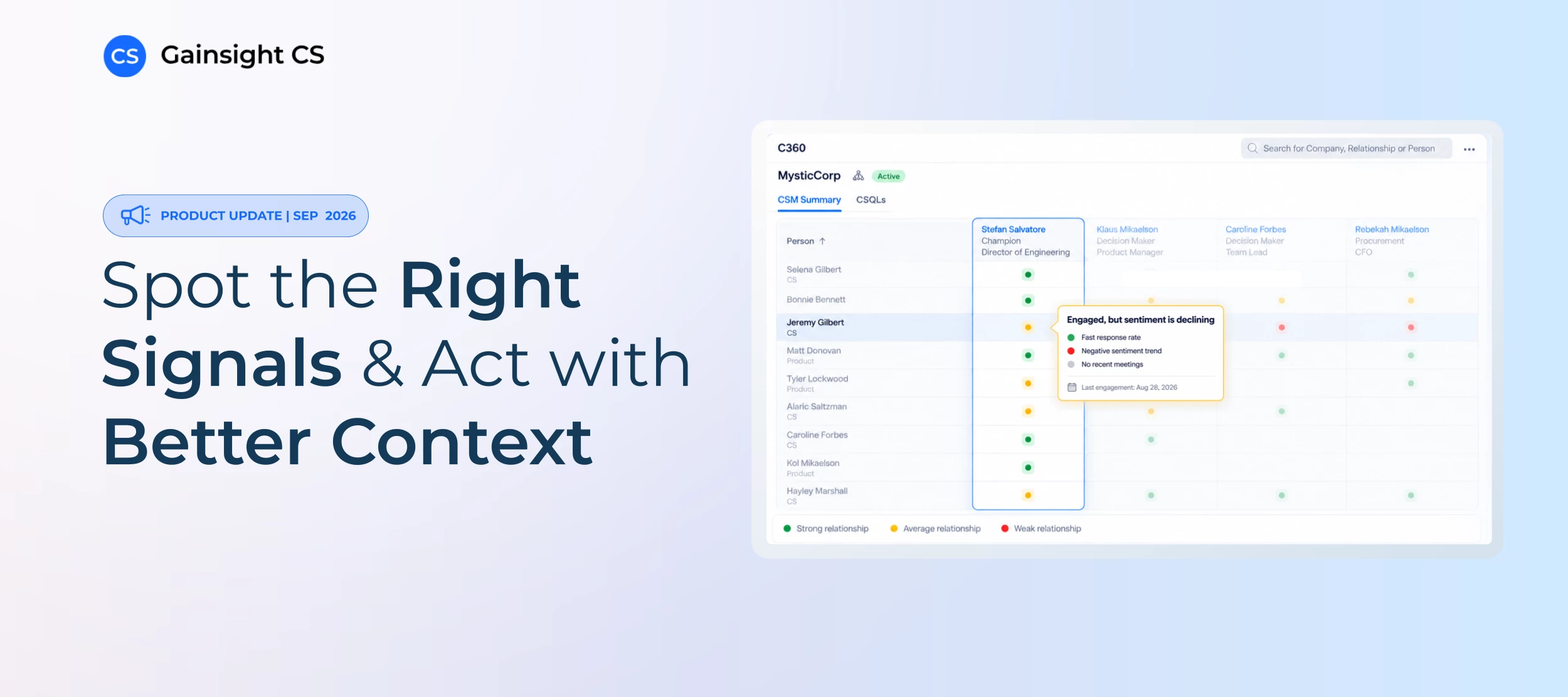
Our September 2026 release is here, and it gives teams more control over the workflows behind their CS motions, more visibility into how their teams are using AI, and better ways to understand what’s happening across customer relationships, stakeholders, and conversations. Build More Flexible Journey Orchestrator ProgramsAs digital programs grow, admins need better ways to manage complexity without rebuilding the same logic or maintaining workarounds outside Journey Orchestrator.This release gives them two additional ways to do that:Clone configured Evaluate elements: Reuse branching logic within a Draft program, then adjust only the conditions that need to change. Exclude participants from another program: Reference another program directly instead of exporting and uploading separate CSV exclusion lists. For example, if your onboarding and adoption programs use similar branching logic, you can clone an existing Evaluate step instead of rebuilding it. And if customers already enrolled in a renewal program shouldn’t receive a separate campaign, you can exclude them directly from that program before you publish. Get a Clearer View of How Your Team Uses AIAs teams bring AI into more of their work through the likes of Model Context Protocol (MCP), it’s becoming increasingly important to understand how — and why — people are using it. The new CS MCP Logs object offers visibility into just that by recording AI tool calls across Copilot, the Gainsight AI Agent in Slack, and Gainsight CS MCP, so admins can report on:Who initiated the request Which tool was used Where the request came from The status of the tool callA new Update Source field for CTAs and Success Plans adds another layer of visibility by showing admins whether a record was created or last updated through Copilot or CS MCP. Keep Customer Activity Connected to the Right RelationshipBetter workflows matter most when the customer context inside them stays accurate.Relationship Resolution, now in beta, ensures that by automatically mapping eligible AI-generated meeting follow-ups (via AI Follow-Up) and auto-captured emails (via Auto Email Capture) to the appropriate product-level Relationship in Timeline. (If Gainsight cannot determine the right Relationship, it keeps the activity at the Company level.)For teams that manage multiple products or business lines within the same customer, that creates a more accurate view of where conversations actually happen. So instead of blending every interaction into one Company history, teams can see activity in the Relationship where it belongs. Understand How Stakeholder Relationships Are ChangingA relationship can look healthy on paper while the dynamics behind it start to shift. For Gainsight CS + Staircase customers, People Heatmap and People Network bring stakeholder engagement into C360 so teams can:See relationship strength over the previous 90 days Open the underlying communication history Understand where stakeholder connections look strong or weakTeams can also surface signals such as disengagement, lack of outreach, title changes, and personnel changes, which all offer a clearer picture of where relationship gaps may exist and which stakeholders may need attention. Ask Better Questions About What Customers Are SayingOnce you can see that something is changing, the next step is understanding what’s behind it. For joint Gainsight CS + Staircase customers, Ask Staircase now works in Copilot, the Gainsight AI Agent in Slack, and Gainsight CS MCP. That brings Staircase communication intelligence into the places CSMs already work, so they can investigate account questions without switching between tools.From there, CSMs can ask qualitative, account-specific questions based on customer communication history across emails, meetings, calls, support tickets, and escalations. For example:What is the current sentiment for Acme? Summarize the Acme account using Staircase and Timeline. What risks are showing up for TechCorp?When available, Staircase citations can also appear inline so users can trace an insight back to its source, which can make it especially useful when a CSM is preparing for a call, reviewing risk, or trying to understand a change in sentiment.  A Few More Updates to ExploreMore precise Timeline configuration: Configure activity types for AI Follow-Up and Auto Email Capture based on how your team works. Custom AI Follow-Up merge windows: Control how related activities get grouped in Timeline. Direct access to Gong.io and Salesloft recordings: Open supported recordings from Timeline without jumping back to the source system. More control over Company Status visibility: Decide where Company Status appears across C360 and the sidebar experience. Greater flexibility in Gainsight Home: Adjust Summary Ribbon placement to better fit how teams use the page. More secure sharing options: Use OTP verification across additional report and dashboard sharing formats.  See Everything in ActionWant to see how the biggest updates work in practice? Watch the on-demand recording of our release webinar below or explore the release notes. 
Skilljar by Gainsight: Configure Multi-SSO (mSSO) Connections Directly from the Dashboard

Skilljar by Gainsight: Configure Multi-SSO (mSSO) Connections Directly from the Dashboard

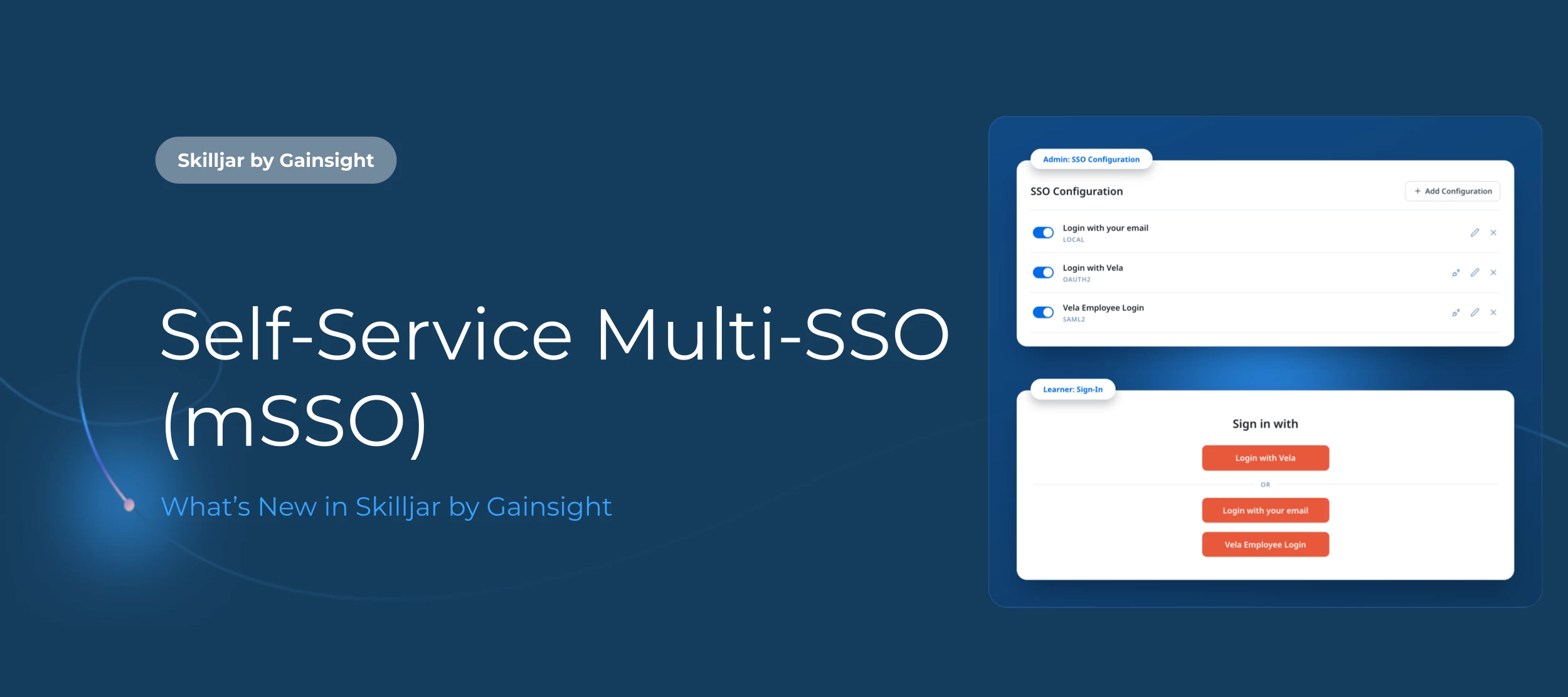
Earlier this year, we made it possible to configure a single SSO connection directly from the dashboard. Now we’re tackling multi-SSO (mSSO) configurations.Whether you work with contractors who need their own login method, or simply want learners to have a password option alongside SSO, getting multiple identity providers set up in Skilljar used to mean engaging with our Professional Services team. Now you can do it yourself, directly from the dashboard. Combine SAML, OAuth, and OIDC on a single domain, and add Native Login (email/password) alongside them so learners always have a password option available.  This is included at no additional cost and on every Skilljar tier.Note: If you've previously worked with our Professional Services team on a custom login experience, this setting won't appear in your dashboard, and your existing setup will continue to run unchanged. Release Notes How does it work?In the admin dashboard, you can add your SSO providers, set the order they appear, and toggle them on or off. When more than one is active, learners automatically see a login selection page with clearly labeled buttons for each option.Note: Because the Skilljar Starter plan runs on a separate authentication system, the setup steps in Domain Settings and learner experience differ slightly from other plans. See the below help article for the exact steps.Admin Experience | Configuring Multi-SSO for Essentials, Professional, and Enterprise PlansLearner Experience | Multi-SSO Login Page for Essentials, Professional, and Enterprise PlansUnder Theming → Languages, you can customize button labels and help text for each login method through your language pack, so learners understand exactly what each option is and when to use it. Get StartedHead to Domains & Publishing → Domain Settings → SSO Configuration to add your first connection.Help Article: Self-Service mSSO For Essentials, Professional, & Enterprise Plans Help Article: Self-Service mSSO For Skilljar Starter   Professional ServicesThe default login page covers most teams’ mSSO needs. But if your organization requires a login flow beyond the self-service functionality, our Professional Services team offers full discovery-through-go-live support to build exactly that. Talk to your Gainsight CSM to learn more.  

Related products:
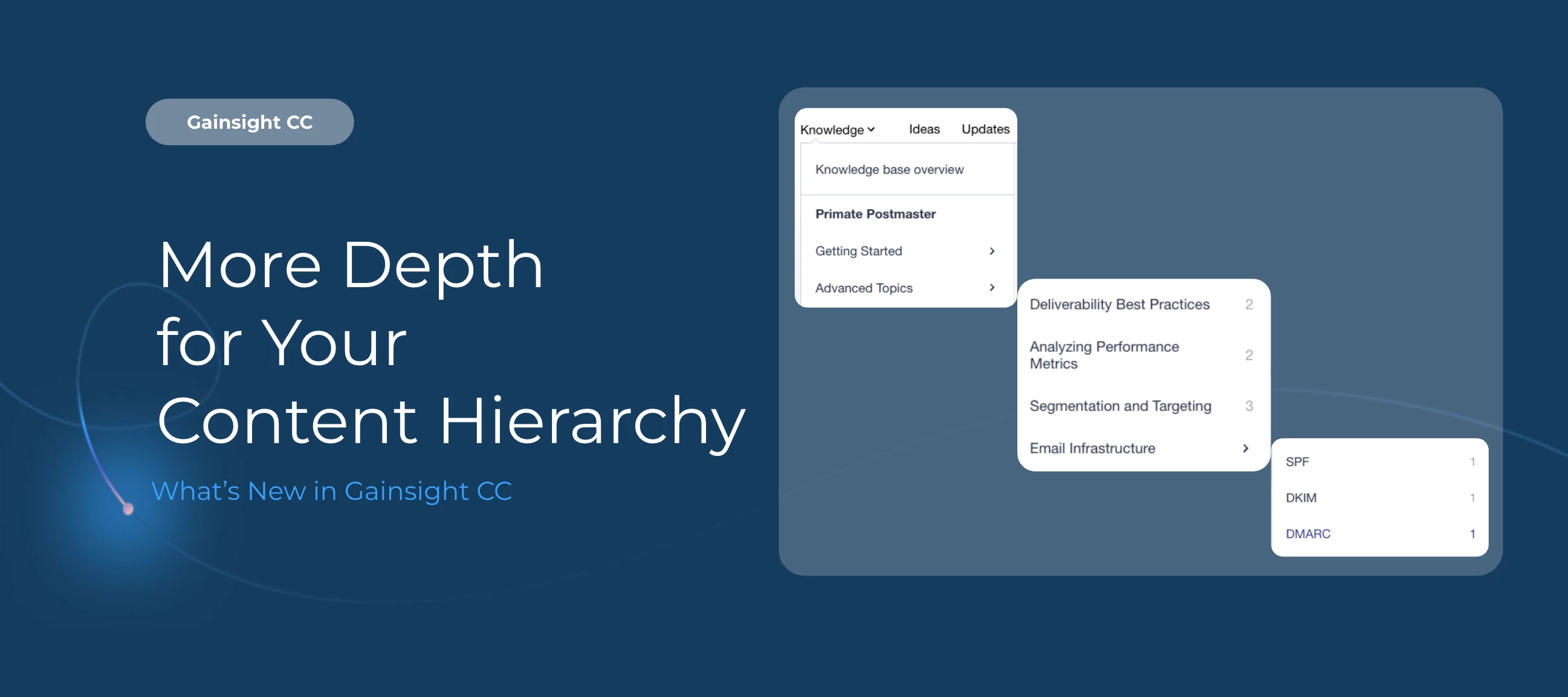
Gainsight CC: Expand Category Depth Up to Five Levels in Community and Knowledge Base
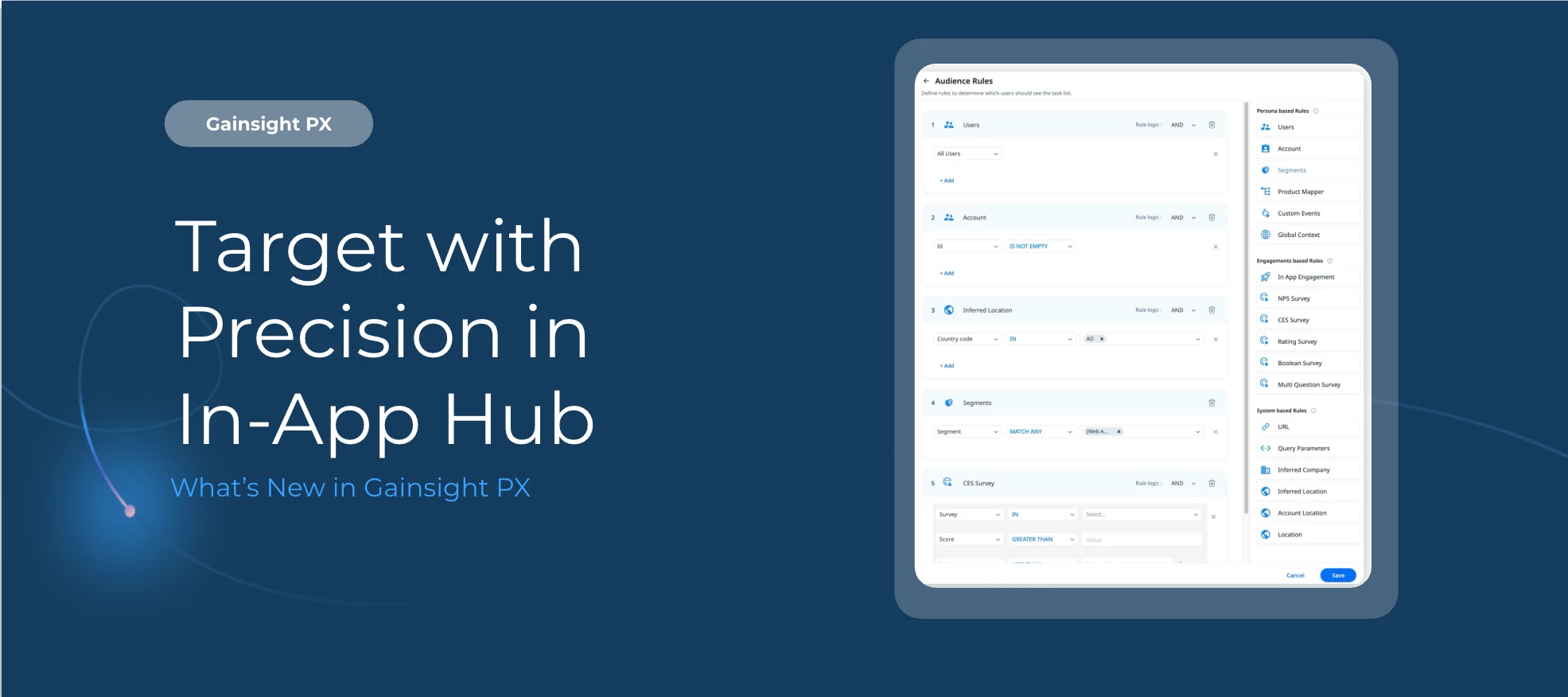
Gainsight PX: Target More Precisely in In-App Hub
CS Heads-Up: September 19th Release Preview

CS Heads-Up: September 19th Release Preview

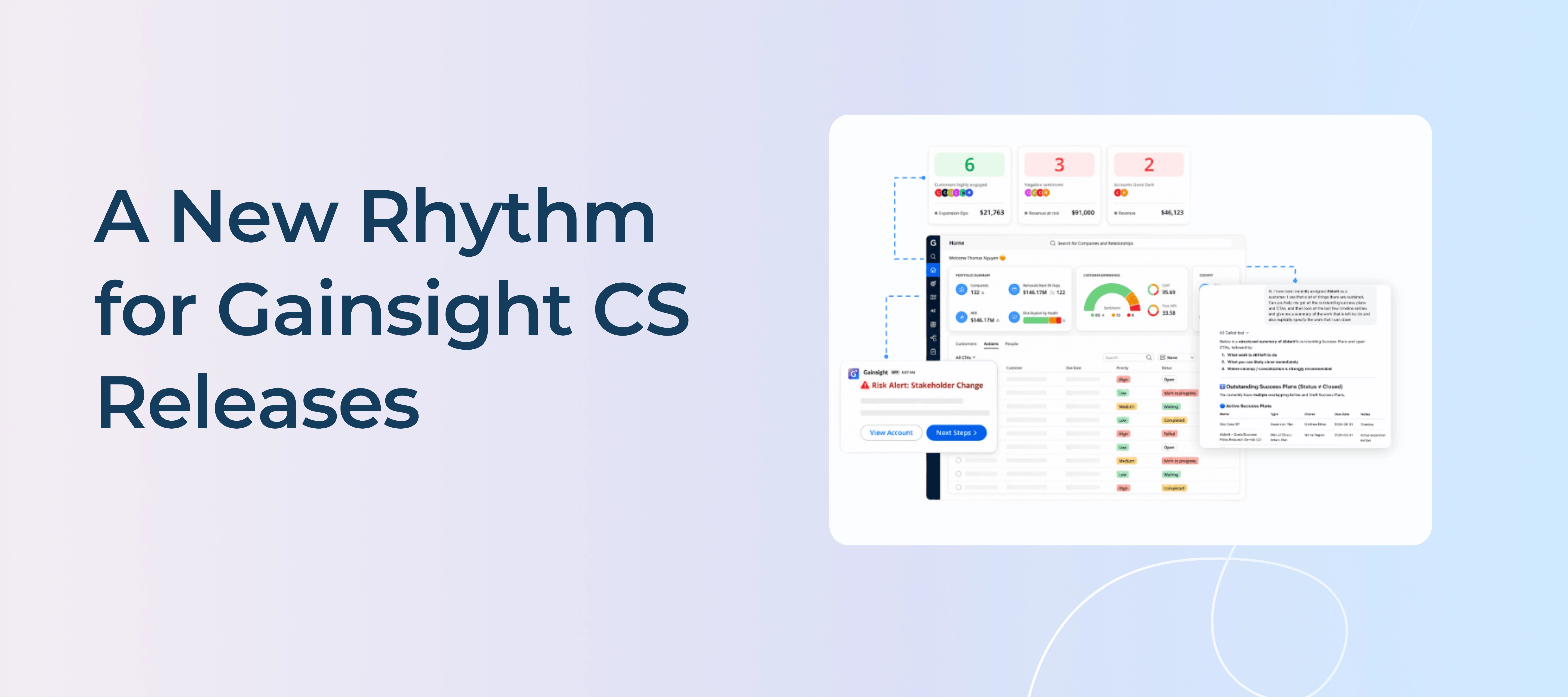
Starting with this release, we're piloting something new: sharing a preview here in Community about a week ahead of launch so you can get an early look at what's coming. This is a lightweight heads-up. Complete Release Notes with full details will still be published on the release date. 360Reposition and Resize Summary Ribbon on Gainsight Home (Admin Controlled): Summary Ribbon on Gainsight Home can be repositioned once admins enable flexible placement in General Settings. After enabling, Admins can drag the ribbon to any vertical position in the Home layout. Enabling the setting is a one-way action. A confirmation dialog box appears before the change takes effect, warning Admins that the action cannot be reversed.   Control Company Status Visibility in C360 and Sidebar (Admin Controlled): Admins can now control whether the company status appears in both the full C360 page and the mini 360 sidebar view. You can configure the Company Status visibility per layout, giving teams the flexibility to display only the information relevant to their organization.   View Stakeholder Engagement in C360 with People Heatmap and People Network, Staircase-CS Integration (Admin Controlled): Now view stakeholder engagement insights directly in C360 through two new widgets, People Heatmap and People Network, available on the C360 Summary page. These widgets provide a complete picture of engagement strength between your internal team members and customer stakeholders without switching to the Staircase application. Note: This feature is available only to customers who have purchased both Gainsight CS and Staircase.   View Stakeholder-Level Insights in C360 and P360, Staircase-CS Integration (Admin Controlled): Gainsight Customer Success (CS) surfaces stakeholder-level AI insights from Staircase directly into C360 and P360. The Person AI Attributes object stores Staircase AI signals at the individual stakeholder level. These insights are also aggregated as counts at the company level in C360, giving you a complete picture of stakeholder engagement across your accounts without switching to the Staircase application. Note: This feature is available only to customers who have purchased both Gainsight CS and Staircase. TimelineConfigure Default Activity Type for AI Follow-Up and Auto Email Capture (Admin Controlled): Admins can now configure the default activity type for activities auto-logged to Timeline through AI Follow-Up and Auto Email Capture. By default, AI Follow-Up activities are logged as Meeting and Auto Email Capture activities are logged as Email.   Configure Activity Merge Window for AI Follow-Up (Admin Controlled): Admins can now define a custom Activity Merge Window for AI Follow-Up instead of a fixed system default. The available options range from ±15 mins to a maximum of ±6 hours.   View Recording Links for Gong.io and Salesloft Activities in Timeline (Automatic Update): Gainsight has enhanced Timeline to include recording links for activities logged through Gong.io and Salesloft using the Staircase integration. CSMs can now click the recording link directly from the Timeline activity to be redirected to the specific page to view the recording.   Relationship Resolution, Beta (Admin Controlled): This feature automatically logs AI-generated meeting follow-ups and auto-captured emails to the correct product-level Relationship, using rule-based matching against Contact and User data. This removes the need for manual tagging. Prerequisite: Requires meeting and/or email sync enabled through the Staircase integration.Journey Orchestrator Clone Evaluate Element in Programs (Admin Controlled): Admins can now clone a configured Evaluate element within a draft program and reuse its logic, instead of reconfiguring the element each time. In larger programs where the same branching conditions repeat across multiple paths, this reduces build time and helps admins keep Evaluate logic consistent. Note: Branch conditions that reference survey answers or previous steps have their values cleared in the clone. Reconfigure these conditions after you connect the step.   Exclude Participants From Another Program (Admin Controlled): Admins can now exclude participants by referencing another program directly, rather than exporting and uploading a CSV file. Journey Orchestrator now excludes any participant whose recipient email appears in the programs you select, which helps keep already-engaged participants from being re-enrolled and messaged twice. Note: Configure the exclusion before you publish the program. After the program is published, the exclusion configuration becomes read-only.MCP, Copilot, Gainsight AI Agent in Slack Ask Staircase in Copilot, Gainsight AI Agent in Slack, and Gainsight CS MCP, Staircase-CS Integration (Automatic Update): Gainsight now brings Ask Staircase into Copilot, Gainsight AI Agent in Slack, and Gainsight CS MCP. Earlier, joint customers had to switch between CS MCP and Staircase to get a complete picture of an account.   Track AI Tool Activity with CS MCP Logs (Automatic Update): Admins can now view a log of all AI tool calls made across Copilot, Gainsight AI Agent in Slack, and Gainsight CS MCP. Earlier, there was no way to track which tools were used, by whom, and when. Note: CS MCP logs do not display historical data. Data is available only for tool calls made after this feature is enabled.   Track CTA and Success Plan Creation Source with Update Source Field (Automatic Update): Admins can now identify where a CTA or Success Plan was created or last updated using the new Update Source field. This field is now available in the Call-To-Action and Success Plan objects. The Update Source field captures the source of creation or last update (Copilot, MCP) for a CTA or Success Plan.Reports Require OTP Verification for Shared Reports (Admin Controlled): Admins can now apply One-Time Password (OTP) verification across all report share types: Link, Excel, Image. Recipients must complete OTP verification before accessing or downloading a shared report. This ensures more secure access across all share types, preventing unauthorized access even if a shared link or email is forwarded to unintended recipients. Data ManagementDesign Customizable Form Layouts for Low-Volume Custom Objects (Admin Controlled): Admins can create and configure form layouts for low-volume custom objects directly in Data Management. Form layouts configured in Data Management surface in the Report Builder and dashboards. Each layout controls which fields appear when a CSM adds or edits a record, how those fields are grouped and ordered, and whether each field is editable or read-only.Note: Features and details shared in this preview are subject to change prior to the release.We're piloting this preview format and may continue to refine how and when these previews are shared. Thank you for your patience as we iterate!

Gainsight CS Patch Release Update - September 14, 2026
Skilljar by Gainsight: Make Your Academy Discoverable by AI Assistants

Skilljar by Gainsight: Make Your Academy Discoverable by AI Assistants

Your customers are increasingly turning to AI assistants for answers; how to configure a feature, which course to take, where to start. When your Academy content isn't readable by those tools, the answer comes from somewhere else: a competitor's page, an old forum thread, or a best guess.How AI tools discover and cite content is still an evolving space, but we didn't want that to stop us from giving your Academy a seat at the table.  What AI Discoverability DoesOur first release of Academy AI Discoverability makes your catalog readable by AI assistants and gives you one setting to control whether AI crawlers are allowed to index your content. When enabled, AI assistants crawl structured metadata on course pages. Your courses carry machine-readable data that tells AI tools exactly what they're looking at: a course, who offers it, what it teaches, and whether enrollment is required. Instead of treating your catalog as just another web page with words on it, AI assistants can understand and accurately represent your training.  How to Turn It OnIn your Dashboard, open Domain Settings for each domain you want to enable. Find the AI Discoverability section and check "Allow AI crawlers to index this academy." What Happens Behind the ScenesThe checkbox controls three files:  File What it Does Can You Change It? robots.txt The file that tells crawlers where they may and may not go.  Unchecked (AI Discoverability off): Skilljar adds a Disallow: / block for 14 known AI crawlers to the top of the file. One block per crawler, each blocking that bot from the your Academy:   User-agent: GPTBot   Disallow: /   User-agent: ClaudeBot   Disallow: /   ... (12 more AI crawlers) ...   Checked (AI Discoverability on): those 14 crawler-specific blocks are removed, and the file reverts to just the baseline shown above. In other words, turning the feature on doesn't add anything to the file, it removes the AI-specific blocking rules that are there by default. Only via the checkbox llms.txt This plain-text file is a machine-readable index of every public course and learning path, including titles, descriptions, and links. It's generated from your live catalog and updates whenever you publish changes. No sitemap.xml Standard list of pages for search engines.  Note: While AI Discoverability is turned off, /sitemap.xml returns a 404 error for all requests, including Google searches. If you rely on your sitemap for SEO, enable AI Discoverability for the relevant domains. No  Learn More   What llms.txt Exposes to AI Assistantsllms.txt will never expose lesson content, video transcripts, quiz questions, or SCORM files. AI tools learn what training you offer, not what's inside it. Private academies return a 404 instead of a listing.llms.txt publishes your Academy name and the title, description, and link for each public course and learning path.A course appears in /llms.txt when it's published, visible on your catalog, and your Academy is checked to allow AI Discoverability. The description shown in AI results is pulled from the course's short description field.  A Quick Note on Best PracticesIf you’re looking to improve how AI tools describe your courses, we recommend keeping the short description field up-to-date and setting a cadence for regular updates. This is a feature worth planning for, not just switching on.For years, discoverability meant optimizing for a ranked list of blue links, getting the keywords right, and hope for page one. AI answer engines work differently: there's no page two. An assistant either has enough signal to cite you, or it reaches for whatever else it can find. This raises the bar on freshness and clarity, and lowers the bar on volume. A handful of clear, current course descriptions will outperform a large but stale catalog.It also changes what "traffic" means. A citation in an AI assistant's answer may never show up as a click in your analytics, but it's still a customer forming an impression of your training before they land on your site. Treating short descriptions as living copy, reviewed on a schedule, is becoming as routine as maintaining meta descriptions was for search. If you want a structured way to approach AEO, check out our 90-Day AEO Checklist, a step-by-step guide to thinking about your strategy before rolling this out more broadly.One area still ahead of us: an authorized learner's own AI assistant pulling course content directly on the learner's behalf. We're actively thinking through that mechanism. What to Expect After You Turn It OnTurning this on doesn't guarantee your Academy shows up in ChatGPT tomorrow; how AI tools decide what to crawl and cite is still evolving. But here's what we know:Crawling takes days to weeks. Every AI provider works on its own schedule, and there's no way to speed it up. Citation isn't guaranteed. You're making your content readable, not buying placement. Whether an AI tool cites you is ultimately decided on the provider's crawl behavior. Recency matters. AI tools tend to favor recently updated content, so an actively maintained catalog is more likely to be picked up.We'll continue to share what we learn about crawler behavior and citation patterns as this space develops. Visit our Help Center article for additional setup instructions and FAQs. Release Notes

Related products:
Introducing a New Release Cadence and Beta Feature Center in Gainsight CS

Introducing a New Release Cadence and Beta Feature Center in Gainsight CS

TL;DRStarting September 19, 2026, Gainsight CS will release new features and enhancements on a six-week cadence.That means one consistent schedule for product updates throughout the year, whether a release includes focused improvements, larger capabilities, or a mix of both. The six-week rhythm also builds on a cadence many customers already know from our On-Demand releases.As part of the change, we’re also introducing the Beta Feature Center, which will give admins one place to discover eligible Open Beta features as they’re introduced going forward. A Simpler Way to Keep Up With What’s NewUntil now, Gainsight CS updates have come through different release motions, including standard and On-Demand releases. We’re bringing those together into one six-week cadence, which gives you a clearer schedule to follow and removes the extra step of submitting a support ticket to access eligible features.Rather than reserving certain types of updates for different release moments, each release can include the features and enhancements that are ready. This gives teams a more consistent rhythm for planning, adoption, and communications without creating long gaps between releases.For features that require admin action or configuration, the experience will remain similar to the standard release process customers are familiar with today. Admins will continue to have visibility into what’s changing and what, if anything, they need to do before a feature is available to users.When each release goes live, you’ll get the full breakdown through Release Notes, in-app communications, and our release newsletter so you can quickly understand what’s new, what requires attention, and where to learn more.With this more frequent release cadence, we’ll also no longer publish separate Early Access Release Notes. Instead, we’ll focus on sharing the most current information at the time of release, when features are ready for customers to use. A New Home for Open Beta FeaturesAs the release cadence becomes more consistent, we’re also updating how admins discover Beta features in Gainsight CS.The Beta Feature Center will give admins one place to discover and manage eligible Open Beta features. Open Betas will align with the six-week release cadence, and their Beta toggles will be removed once the feature becomes generally available. What’s Next?The first release under the new cadence is September 19, 2026, followed by the next release on October 31, 2026. From there, you can expect a new Gainsight CS release every six weeks.With each release, we’ll share details on what’s included and call out any setup, configuration, or preparation admins should be aware of. The goal is a release process that’s easier to follow throughout the year, with one consistent rhythm for what’s new and what comes next.

Gainsight CC: Manage Translations at Scale with Bulk Phrase Export and Import

Gainsight CC: Manage Translations at Scale with Bulk Phrase Export and Import

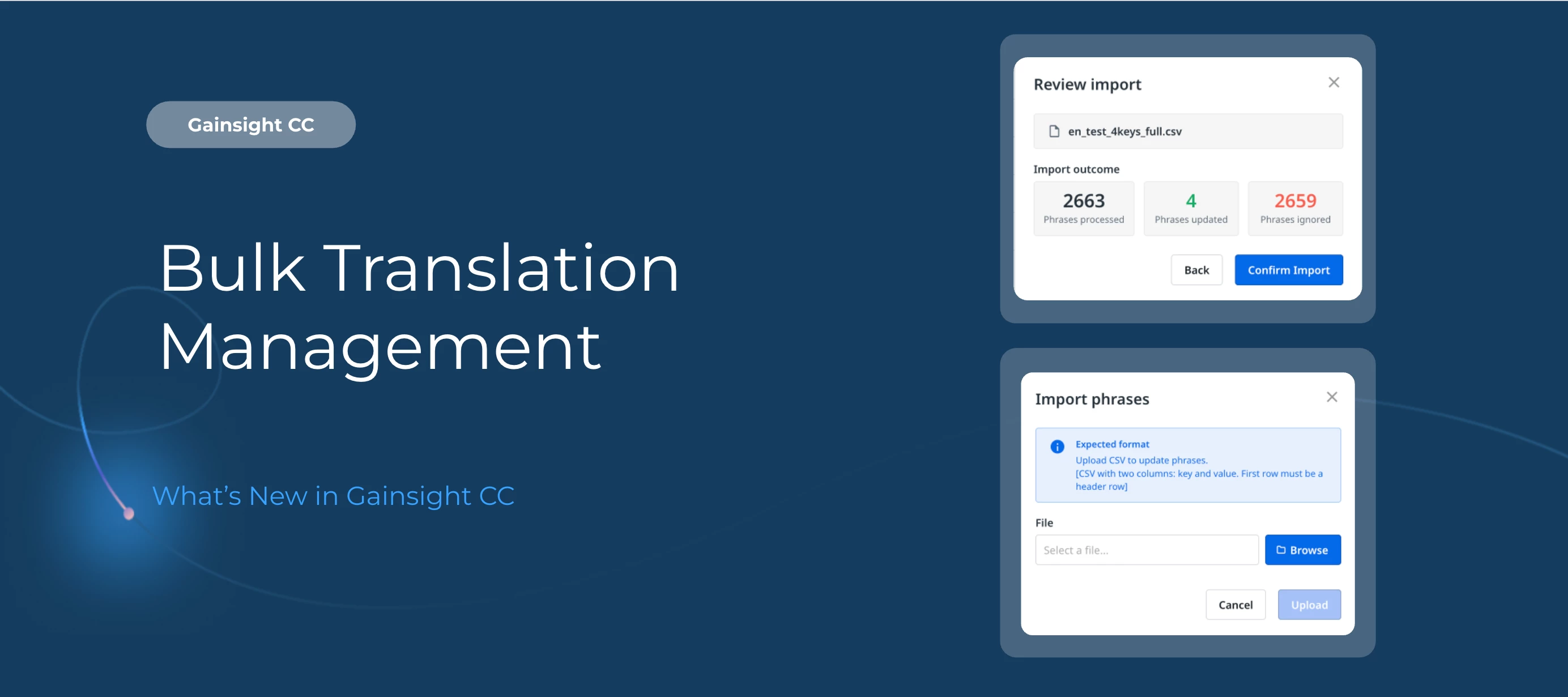
Updating community translations one phrase at a time is slow work. Now you can export your full phrase library to CSV, edit translations in bulk outside of CC, and import everything back in one go.Here's What's NewExport phrases by language or all at onceOn the Phrases Overview page, select a language from the dropdown and click Export to download a CSV for that language. Need everything at once? Click the dropdown arrow next to Export and select Export all languages to get a single file covering every configured language.A CSV format built for editingEvery exported file uses four columns: module, key, phrase, and language. The structure is simple enough to work with in any spreadsheet application, and consistent enough to import back without reformatting.Review before you commitWhen you're ready to bring translations back in, click Import on the Phrases Overview page and upload your updated CSV. Before any changes are applied, the Review Import dialog shows a summary of phrases processed, updated, and ignored, so you can confirm everything looks right first.Getting StartedBulk phrase export and import are available now on the Phrases Overview page in Customer Communities Control.For more information, refer to the How to Export and Import Phrases article.👉 Check out the Release Notes for more details.💬 Have a question for ​@Sudhanshu? Drop a comment below! 

Related products:CC Languages & Localization
Gainsight CS Patch Release Update - August 27, 2026

Gainsight CS Patch Release Update - August 27, 2026

The patch release includes enhancements across Timeline, and Journey Orchestrator.IMPORTANT:The Control Email Open Tracking with Recipient Consent feature is available to all customers from August 28, 2026 The features below are available to EU customer from August 28, 2026For more detailed information on each of the features below, refer to the CS Release notes here Enhanced Microsoft App Permissions for AI Follow-UpGainsight has updated the Microsoft app permission for AI Follow-Up from Read all users' full profiles to Read all users' basic profiles, following the principle of least privilege.For more information, refer to the AI Follow-Up and Auto Email Capture Admin Guide article. Retro-Link Attendee Email IDsTimeline automatically links external attendees previously logged as email IDs on historical activities to their corresponding Company Person or Relationship Person record upon creation of that record.For more information, refer to the AI Follow-Up User Guide article. Improved Email Logging for Long EmailsGainsight supports logging emails that exceed 131,000 characters to Timeline. Previously, emails exceeding this limit were discarded. Such emails are now truncated and logged.For more information, refer to the Gainsight Assist Chrome Plug-in User Guide and Gainsight Assist Outlook Add-in User Guide articles. Timeline API: Additional Context Types for Activity LoggingThe Timeline API now supports CTA, Success Plan, and GS Opportunity as additional context types for activity logging, alongside the existing Company and Relationship contexts.For more information, refer to the Timeline APIs article. Control Email Open Tracking with Recipient ConsentAdmins can control whether Gainsight tracks when recipients open their emails and give recipients the choice to decide for themselves. Previously, Gainsight tracked email opens for all recipients by default with no option to restrict or opt out.For more information, refer to the Email Template Builder article. 

Related products:CS Journey OrchestratorCS Timeline & Activity Tracking
Gainsight CC: Smarter Moderation and Tagging, Powered by AI

Gainsight CC: Smarter Moderation and Tagging, Powered by AI

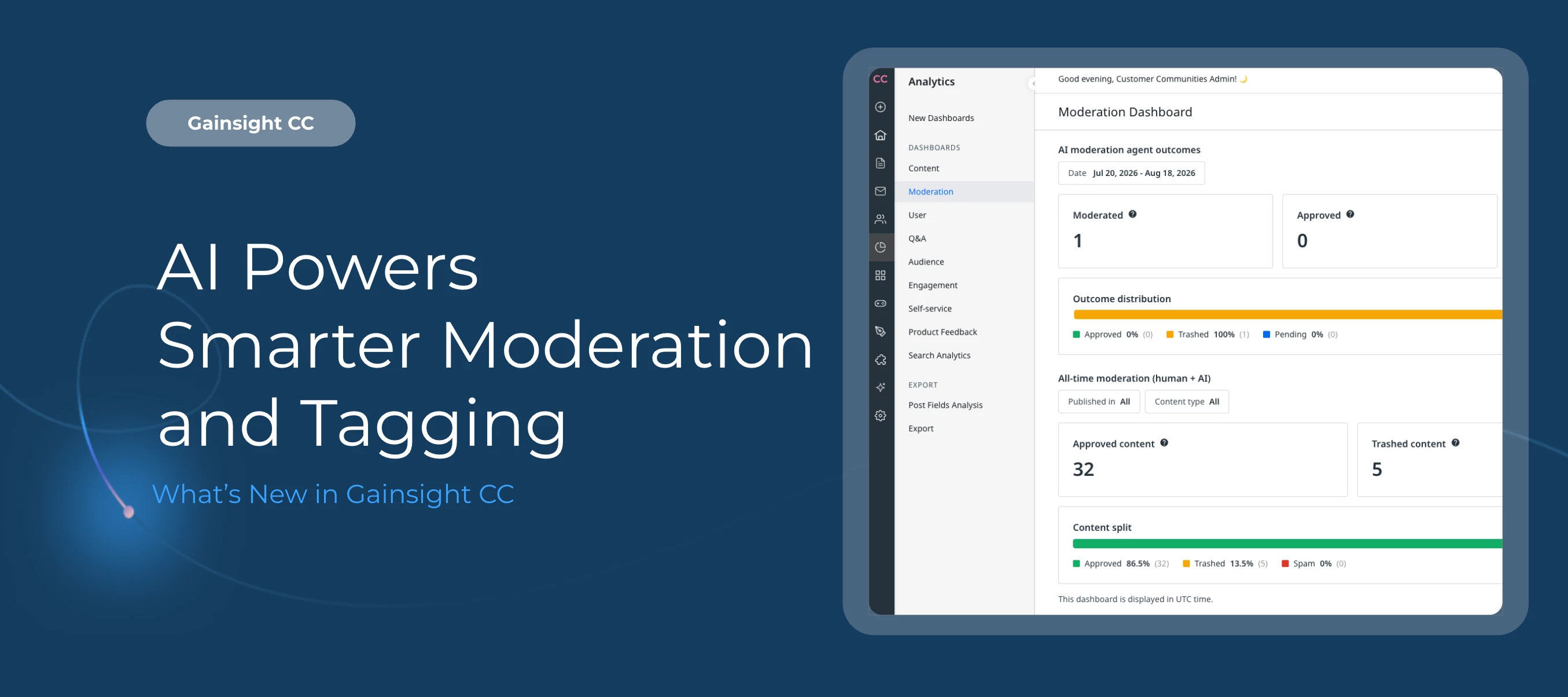
Two new features give community managers better visibility into moderation activity and help members tag content accurately with less effort.Here's What's NewView Moderation Activity in the New Moderation DashboardThe Moderation Dashboard gives community managers a dedicated place to review moderation activity across their community, covering both human moderator actions and decisions made by the AI Moderation Agent.The dashboard surfaces two distinct sets of data: AI Moderation Agent outcomes: Counts of content Moderated, Approved, Trashed, and Pending within your selected date range. These figures reflect AI agent decisions only and require the AI Moderation Agent to be enabled. All-Time Moderation Totals: Cumulative counts since your community launched, across all moderators (human and AI combined). These totals are not affected by the date range filter.  For more information, refer to the Moderation Dashboard article.Improve Content Discoverability with AI-Assisted TaggingTag Assist uses AI to recommend relevant tags as members create posts, reducing the effort required to tag content accurately and keeping your tag taxonomy consistent over time.As a member drafts a post, Tag Assist analyzes the content and surfaces suggestions inline, drawn from your community's existing tag library. Members stay in full control: suggested tags can be accepted, ignored, or replaced with their own.For more information, refer to the Configure AI Tags article.A Note on Recent Label ChangesAs part of the Threaded Replies update released earlier, you may notice two small label changes in the community interface. The functionality behind both is unchanged: Upvote on ideas now appears at the bottom of a post alongside other actions, rather than at the top. Subscribe has been renamed to Follow on posts and ideas. These are intentional UI updates that shipped with Threaded Replies. No action is needed on your end.Getting StartedBoth features are available in your community now. To access the Moderation Dashboard, navigate to Analytics in Customer Communities Control and selection Moderation. Note: AI outcome data is only visible when the AI Moderation Agent is enabled. Tag Assist works automatically when members create posts. No additional configuration is required to surface suggestions. 👉 Check out the Release Notes for more details.💬 Have questions or feedback for ​@Larry? Drop a comment below — or better yet, ask our new AI!

Related products:CC Analytics & ReportingCC AI
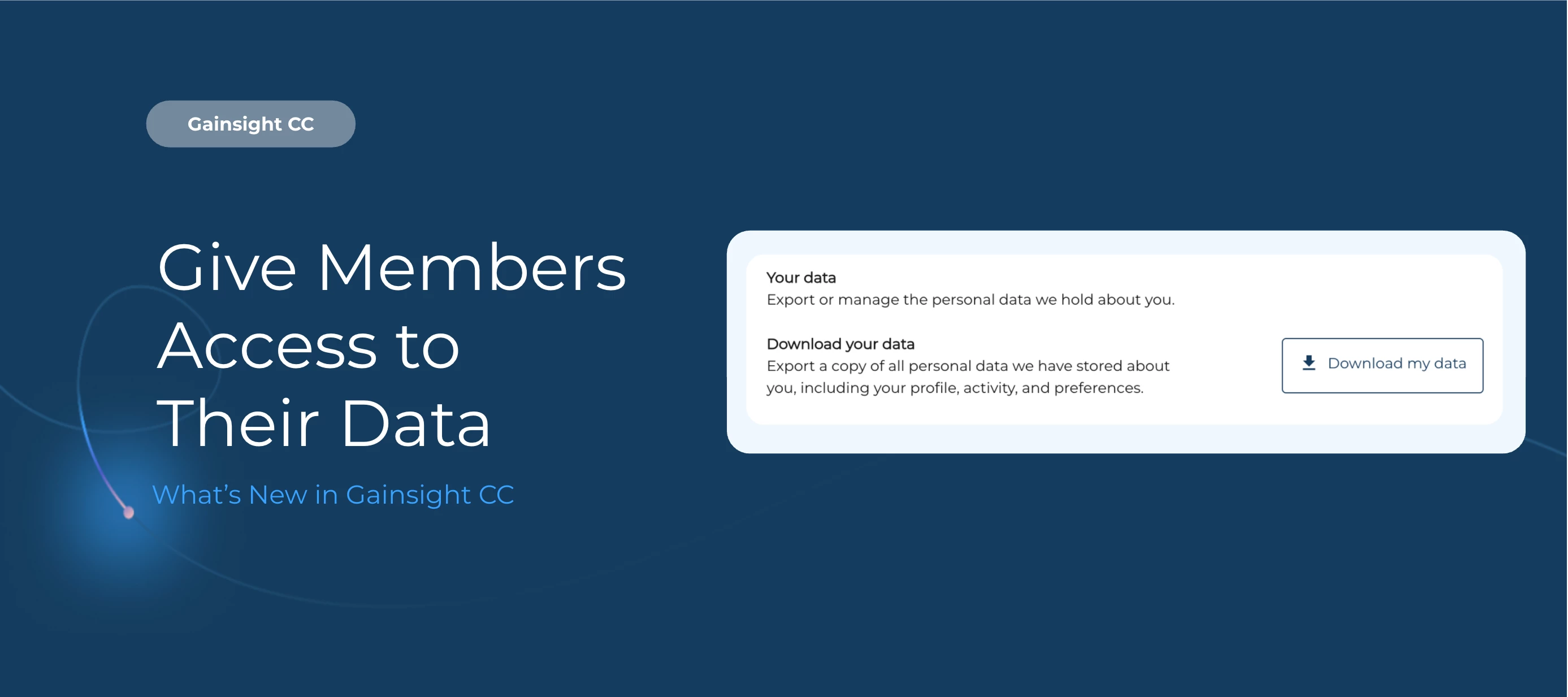
Gainsight CC: Give Members Control Over Their Personal Data
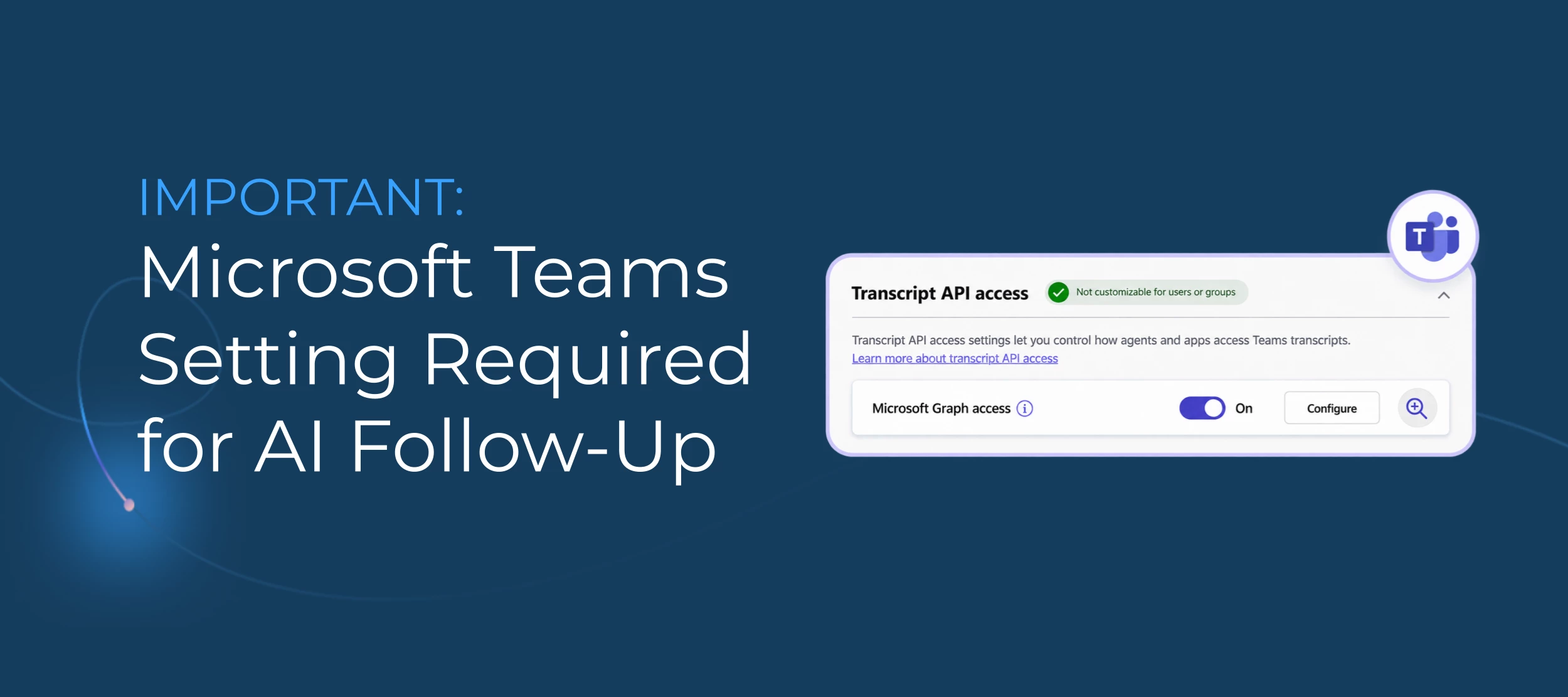
Important: Microsoft Teams setting impacting AI Follow-Up
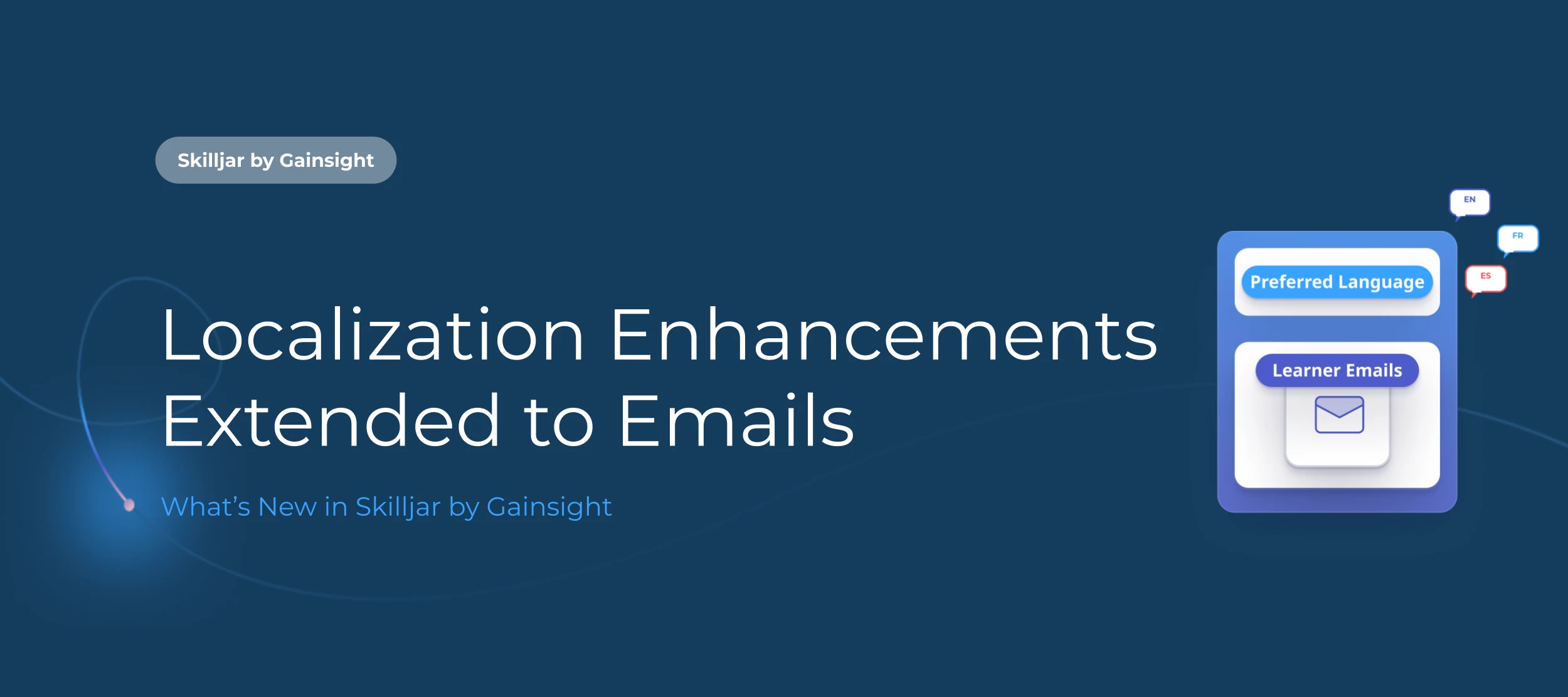
Skilljar by Gainsight: Learner Emails Now Arrive in Their Preferred Language

Skilljar by Gainsight: Learner Emails Now Arrive in Their Preferred Language

If you educate learners in more than one language, you've probably noticed the gap: your training site is localized, but the some of the emails Skilljar sends: password resets, verification links, and invitations, don’t always show up in their preferred language. Skilljar now sends four key account emails in your learner's language instead of defaulting to English:Password reset Email verification Email change confirmation Enrollment and domain invitationsLearn MoreThis feature is on by default. As long as your training site lists the languages you offer, these emails will automatically send in each learner's preferred language. See below for how our system decides which language to use. How Skilljar Chooses the LanguageSkilljar’s system picks the language for each email using the first of these it recognizes:The learner's saved language preference: This functionality was released earlier this year and allows your learners to choose their preferred directly on your training site. Once set, it's remembered and used in the localized emails listed above. The language they're actively using on your site: This only applies to the email change confirmation, since that's the one email sent while the learner is browsing. Your organization's default language: The primary language in the priority order you established when you set up your languages. This is the fallback when the first two aren't available. What's Not ChangingCourse emails: Registration confirmations, completion emails, and VILT reminders are not part of this release and behave exactly as they do today. No additional email changes: These are Skilljar-provided translations of the standard email templates currently available. Release NotesHelp Article

Related products:
Skilljar by Gainsight: MCP Server Now Available in Claude Chat, ChatGPT & More

Skilljar by Gainsight: MCP Server Now Available in Claude Chat, ChatGPT & More

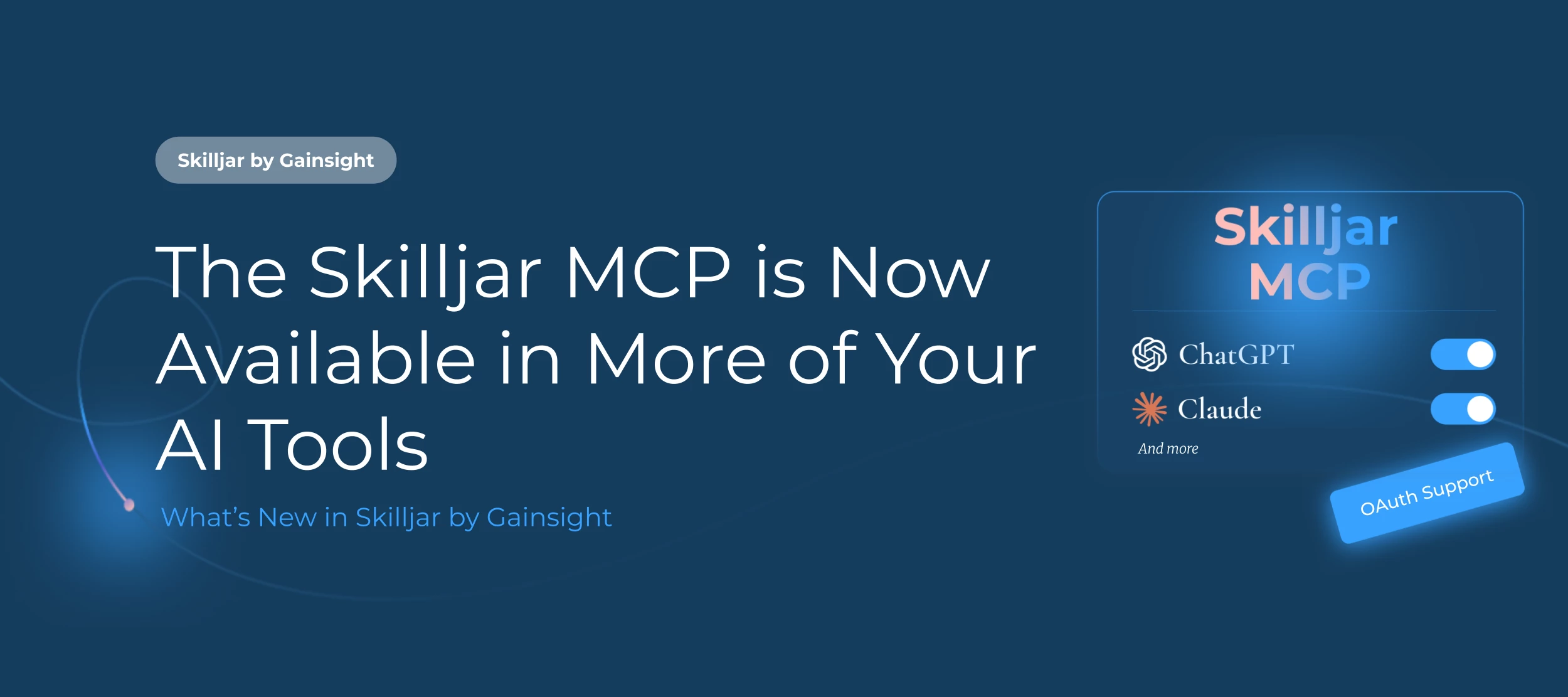
Since its release into beta, the Skilljar MCP server has been available in CLI tools like Claude Code and Cursor. Starting today, OAuth support unlocks usage in Claude.ai (web and desktop), ChatGPT, Copilot, and Gemini.What is OAuth?OAuth (Open Authorization) is a secure sign-in standard. For you it means you connect Skilljar to your AI assistant by logging in with your Skilljar account, rather than copying API keys.How to connect:Add https://mcp.skilljar.com/mcp as a connector in your AI assistant of choice, sign in with your Skilljar account, and approve access. No keys to copy, Skilljar registers itself automatically.What's supported:Claude.ai web and desktop: Pro, Max, Team, or Enterprise plan ChatGPT: Plus, Pro, Business, Enterprise, or Edu plan Microsoft Copilot (via Copilot Studio) Google Gemini CLI and Gemini Enterprise (partial support)On Team, Business, and Enterprise plans, a workspace admin typically needs to add the connector before individual users can connect. Visit the individual support articles for specific tool setup.Help Article with Technical Setup  Not sure where to start? ✨Browse ready-to-use prompts for the Skilljar MCP, and every other Gainsight MCP, in our new MCP Library. We will be adding additional prompts and skills as we add new endpoints, so check back soon! Just some of the things you can do with Skilljar MCP once connected:Create courses with HTML lessons from a single prompt Update lesson content, title, or order Enroll learners via group or email Organize learner groups conversationally Translate courses into any languageAlready connected via the earlier setup? Your existing connection will continue to work. When you're ready to switch, remove the old API credential, reconnect via OAuth, and revoke the old credential from your Skilljar dashboard.Full Release NotesGet Started    

Related products:
Skilljar + Gainsight Customer Communities Integration Enhancements

Skilljar + Gainsight Customer Communities Integration Enhancements

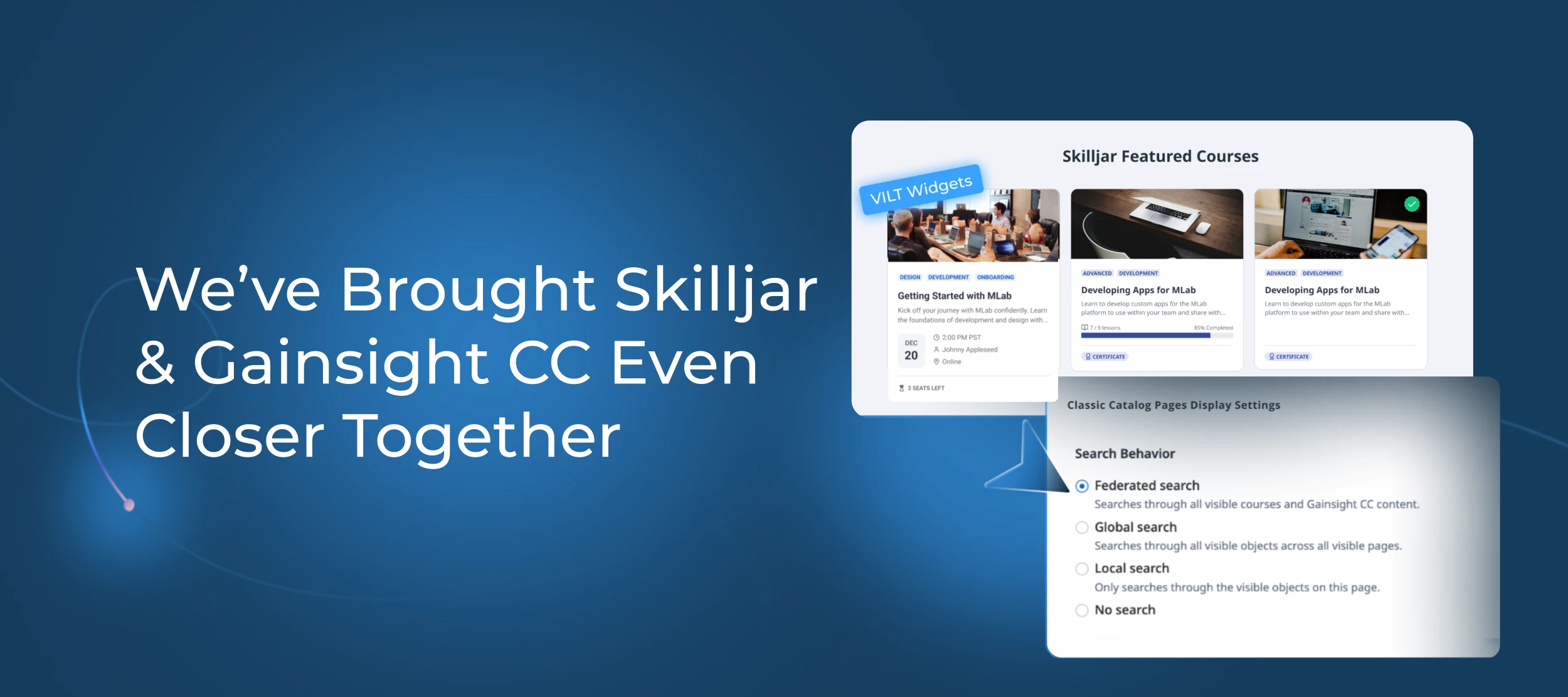
When we launched the Skilljar + Gainsight CC integration earlier this year, it connected your Academy and Community into one experience—unified login and navigation, education widgets on community pages, and federated search. These updates take that foundation further and make the integration work for more of your users.Federated Search on Classic Catalog PagesFederated search now works on Skilljar's Classic Catalog Pages, not just modern Builder Pages. When added, the search banner replaces the hero banner on Classic Pages and delivers the same unified search experience, pulling results from both Skilljar and Gainsight Customer Communities in one place.Learn MoreAdding Federated Search to Classic Pages is done in Domain → Display SettingSkilljar VILT Event Widgets on Community PagesTwo new widgets are now available in the Community widget library under the Education category, right alongside the existing Skilljar Course and Learning Path widgets. These are purpose-built for virtual instructor-led training (VILT) events:Upcoming Events: Promotes events a user hasn't registered for yet, helping drive discovery and enrollment directly from Community pages. Registered Events: Reminds users about events they've already signed up for, keeping attendance top of mind.If you're running live training alongside on-demand courses, these widgets let you surface that content where your Community members are already spending time. Admins can add them to any Community page, just like the existing Education widgets.Learn More(Left) Widget to register for upcoming event, (Right) widget for registered eventSkilljar Widget Configuration ImprovementsWe've cleaned up how admins configure Skilljar content widgets in Community. The configuration panel on the right side of edit mode has been reorganized so all options are grouped more clearly in one place, making it faster to find and adjust settings.We also updated the copy on course tile toggles to make the labels more self-explanatory. Default settings are set to show everything, and admins can untick options to hide specific elements from the widget tile. These changes apply across all widgets that display Skilljar content, including enrolled Courses and public Learning Paths.Learn MoreImproved Skilljar widget configuration in Gainsight CCSearch reaches more pages, Community features live Skilljar training, and setup takes fewer clicks. If you’re already using the integration, let us know what you think! Getting StartedRelease NotesHelp ArticleGot questions? Drop them below 👇

Related products:CC Integrations
Gainsight CC: Richer Community Insights, Smarter Profiles, and More Accurate Idea Data

Gainsight CC: Richer Community Insights, Smarter Profiles, and More Accurate Idea Data

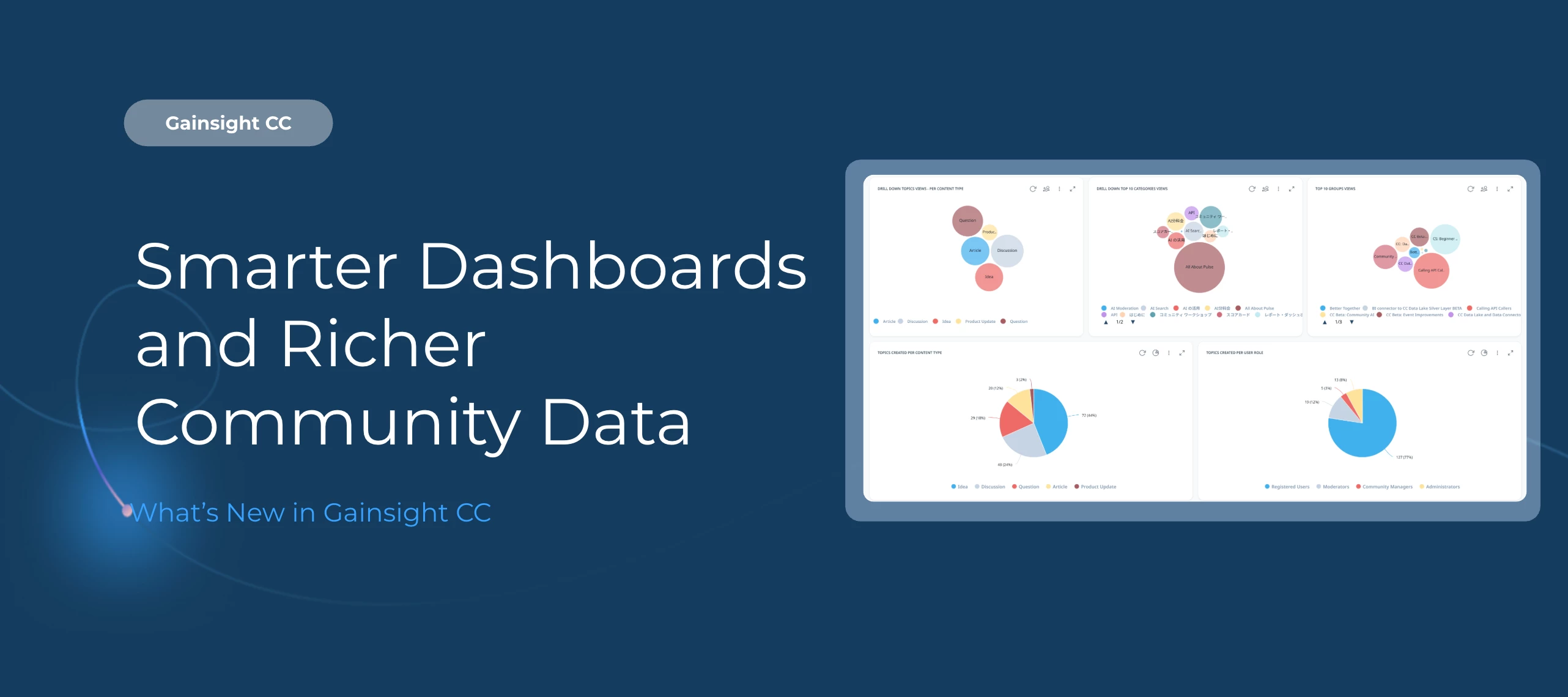
Nine out-of-the-box Community Dashboards are now generally available, five of them have been enhanced with deeper analytics, Profile Field Mapping now supports all CS objects, and Idea Export v2 now delivers complete, all-time vote counts.Here’s What’s NewNine Out-of-the-Box Dashboards Generally Available on August 27thAll Gainsight CC customer will have access to nine purpose-built dashboards covering community activity, customer engagement, Q&A trends, and more. Each dashboard includes modern visualizations and a built-in KPI reference guide. The full set includes: Audience Dashboard Content Dashboard Engagement Dashboard Product Feedback Dashboard Q&A Dashboard Self-Service Dashboard Subscription Status Subscription Trend User Dashboard Navigate to Analytics > New Dashboards to get started.Enhanced Dashboards with Deeper Drill-Downs and Trend DataFive dashboards have been updated with new widgets, trend charts, and drill-down capabilities.Q&A Dashboard: New trend charts for questions and answers over time, plus widgets for unique questioners and best answer contributors. A new role breakdown chart shows the split between peer and employee contributions.User Dashboard: New drill-downs on registrations, posts, and reactions let you click through to individual user details. A new Active Users KPI captures anyone who posted or reacted in a given period, and three new trend charts track total active users, users with at least one post, and reaction-only users.Content Dashboard: New view breakdowns by category, content type, and group, plus a total topic views scorecard. A helpfulness votes split chart and post drill-downs round out the updates. Popular Categories and Popular Topics tables now include IDs.Subscription Dashboards: A new scorecard and trend chart track Events page subscriptions, with drill-down into individual subscribers and unsubscribers.Map Any CS Object to Community User ProfilesProfile Field Mapping now supports all available CS objects, including all standard and custom objects. Community managers can pull in data from any part of the customer record in CS, making community profiles richer and more useful for personalization and segmentation.Complete Vote History in Idea Export v2Idea Export v2 previously only included votes cast from January 1, 2021 onwards, which could cause discrepancies between exported totals and what appeared in Control. Exports now reflect the complete, all-time vote count for every idea. The previous "Historical Date Limits" note has been removed.Getting StartedDashboards are available now at Analytics > New Dashboards in Customer Communities Control. Profile Field Mapping is configurable from the User Profile Fields Mapping settings in Control. The Idea Export fix is applied automatically with no configuration required.Thank you to ​@leah.breen and ​@tiffany.oda for contributing great ideas that led to these enhancements! Idea links: Add “Total Views” Summary to the Content Dashboard in Analytics & Aggregate dashboard component for Content Helpfulness Score👉 Check out the Release Notes for more details.💬 Have a question for ​@Aleksandra ? Drop a comment below!

Related products:CC Analytics & ReportingCC Ideation
From Customer Context to Action: The July 2026 Gainsight CS Release

From Customer Context to Action: The July 2026 Gainsight CS Release

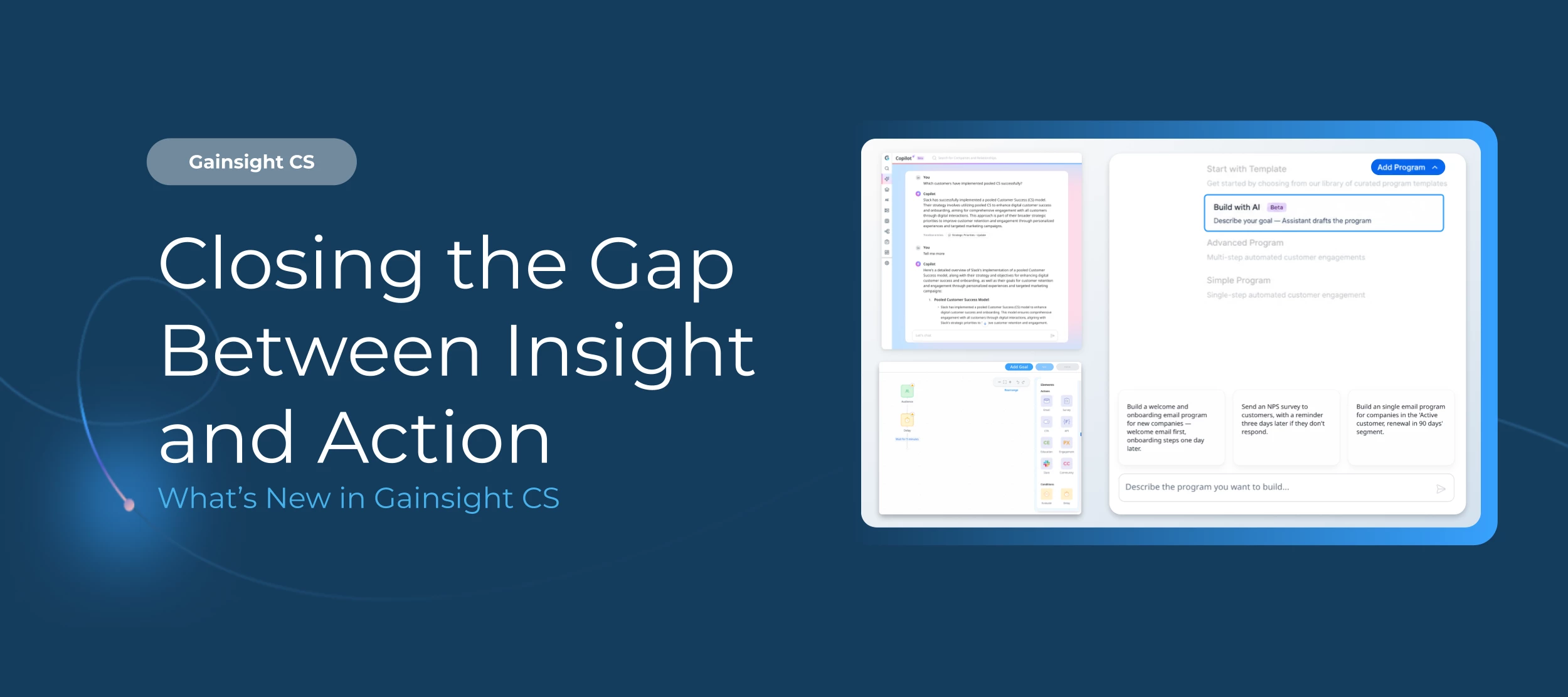
Our July release is here and it revolves around something simple: you should be able to get the right context, act on it quickly, and understand whether those actions are making a difference.That starts with giving AI more of the context already available in Gainsight. It continues by making it easier for you to take the next step from the same conversation. And for admins, it means new ways to build, manage, and measure customer programs without losing control over how they are configured.Here are the highlights: Bring More Customer Context into Your AI Workflows Gainsight MCP can now work with more of the information already in your Gainsight instance, so you can ask questions in your own words and get answers that make sense for how your organization works.It can now reference eligible Gainsight reports to understand your internal terminology and retrieve the right data for your question. It can also add fields or filters, change unlocked filter values, and remove unlocked filters that don’t apply.MCP can also use the Company and Relationship filters configured on your Gainsight Home to understand what “My Portfolio” means for you. When you use that phrase in a question, it automatically applies your filters and returns the Companies or Relationships that fall within your portfolio.From there, you can find the right people within those accounts. Ask for contacts associated with a Company or Relationship and narrow the results by details such as role or title.For more information, refer to the Set Up Gainsight CS MCP Server Integration article.Move from Customer Questions to Customer Actions Finding the right information is only part of the job. You also need a clear way to act on what you learn.Copilot and the Gainsight AI Agent in Slack now support Relationship data in addition to Company data, meaning you can ask questions across Companies and Relationships from Copilot, R360, or Slack. From there, you can create or update Timeline activities, CTAs, Success Plans, and Tasks directly from the conversation.For a CSM, that could mean investigating an account, understanding what needs attention, and recording or assigning the next step while the context is still fresh. The result? Less switching between different areas of the platform and less distance between finding an insight and acting on it.For more information, refer to the Copilot Overview article. Give Admins a New Way to Work with Configurations The Gainsight Admin CLI gives Super Admins another way to understand and manage supported configurations. After connecting an AI agent with tool-use capabilities, such as Claude, you can describe what you want to review or change in plain English. The agent then selects and runs the appropriate CLI commands before returning its findings or confirming the changes it made.For example, you could ask the agent to:Summarize configurations Document an instance Identify possible gaps or redundancies Propose an approach for a new processAdmin CLI currently includes read and write capabilities for Data Designer Templates, Data Management, and Journey Orchestrator. At the same time, it provides read-only access for Connectors, Rules Engine, Scorecards, and Reporting.For more information, refer to the Configure Admin CLI article. Create the Starting Point for a JO Program with AI A new Journey Orchestrator program often starts with a general idea of the experience you want to create. Build with AI gives you a faster way to turn that idea into a structured first draft.Describe the journey in your own words, whether you’re planning an onboarding program, renewal outreach, a re-engagement campaign, or a product adoption journey. The assistant then draws from resources already available in your instance, including published programs, email templates, surveys, segments, and out-of-the-box best-practice templates, to recommend a program structure.From there, you review the audience, sequence, selected assets, and program steps, and then make any changes the journey requires.Note: Build with AI won’t publish the program for you, and unsupported elements such as Evaluate steps or conditions still need to be added manually. You remain in control of the final experience and decide when it’s ready to publish.For more information, refer to the Create Programs Using Build with AI article. Measure Whether JO Programs Change Customer and Business Outcomes Open and click rates can tell you whether someone engaged with a message, but they don’t show whether anything changed for the customer or the business. Program Goals give you a clearer way to connect a newly created JO program to a measurable result.Admins can define goals based on changes in Company or Relationship data, such as an improved Health Score, a lifecycle stage change, or an updated renewal date. They can also map a financial field, such as Annual Recurring Revenue, to participants who meet the goal.Once the program is live, the Goal Completion and Financial Attribution views in Program Analytics show whether participants reached the intended outcome and the value associated with those results, helping teams move beyond asking whether someone engaged with a message and truly understanding whether the program contributed to a meaningful change. For more information, refer to the Configure Program Goals article. Update Execution Schedules without Starting Over Once a program goes live, its timing may still need to change as regional needs, internal schedules, or communication plans evolve. Admins can now make those updates directly within an active dynamic program by changing the execution days, time range, or time zone for email and action steps. They can also add an Action Execution Schedule even if one wasn’t configured before the program was published.The rest of the journey stays in place, which means teams can adjust when messages and actions go out without stopping, cloning, or rebuilding the program.For more information, refer to the Program Elements article.Explore the Full Release There’s more in the July 2026 release than we could cover here, with additional updates to AI Cheat Sheet, Customer Goals, Group Send, Spaces, Timeline, reporting, security, and other areas of Gainsight CS.Dive into the full July 2026 release notes for all the details, or watch the webinar for a closer look at some of our biggest updates. 
Gainsight PX: Build Custom Metrics with the Enhanced Query Builder

Gainsight PX: Build Custom Metrics with the Enhanced Query Builder

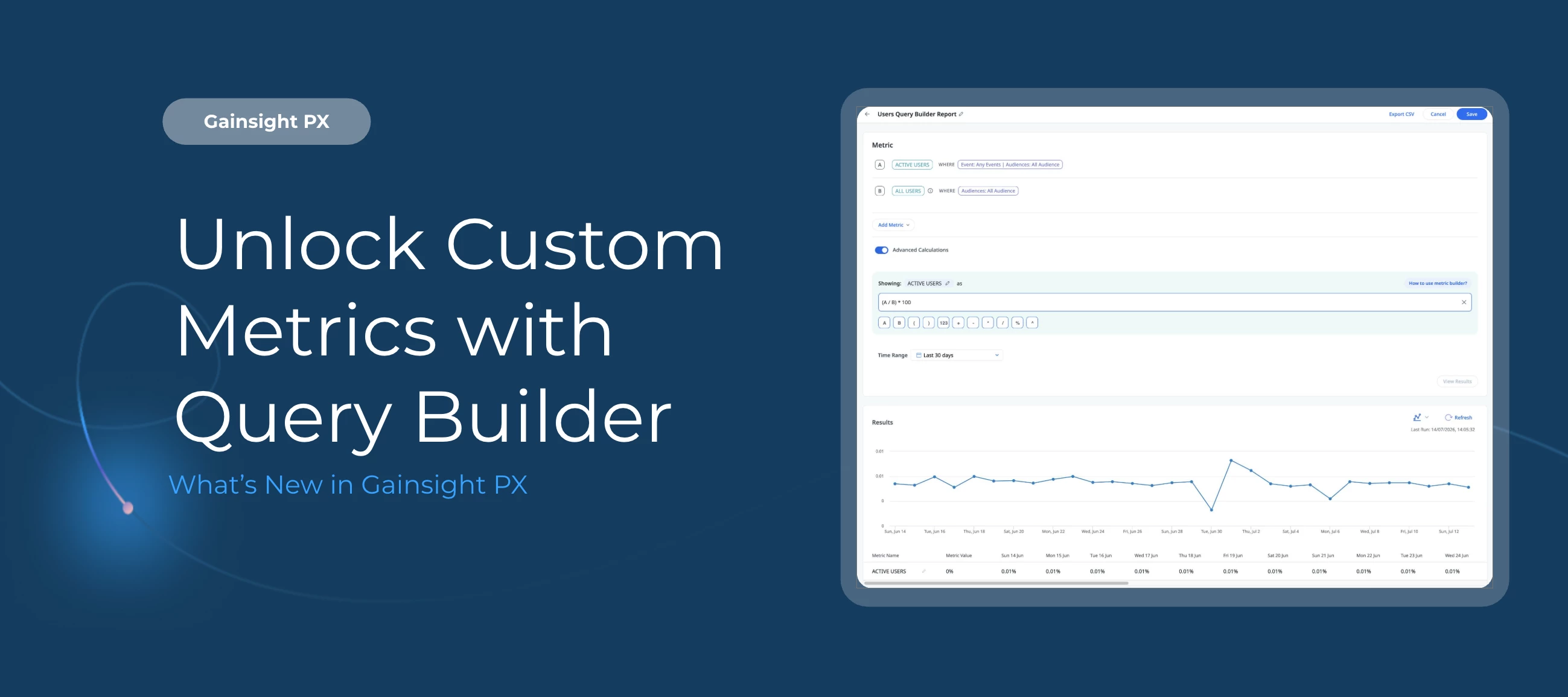
This release brings updates to Query Builder, Path Analyzer, and Badge Icon engagements. Query Builder now goes beyond cohort analysis, letting you define custom metrics and apply formula-based calculations directly in PX without exporting data to an external tool. Path Analyzer adds two new time-based metrics to help you understand how long users take to move through a path. And Badge icon engagements now support displaying custom images in their original shape and aspect ratio.Here’s What’s NewQuery BuilderA new Metrics experience alongside the classic Cohort viewQuery Builder now includes two modes: the new Metrics experience and the existing Cohort view. Switch between them depending on the analysis you need. Both are accessible from the same place.Pre-built PX metrics for fast reportingSelect from a library of standard metrics such as new users, active users , total events and more to build reports quickly without starting from scratch.Custom metrics using aggregate functions and filtersDefine your own metrics using Sum, Average, Count, and other aggregation functions applied to user attributes, account attributes, or custom event properties. Refine any metric further using filters on events, user attributes, account attributes, and custom event properties to zero in on exactly the data that matters.Formula builder for combined metricsCombine multiple metrics using standard mathematical operators (+, -, *, /, %, ^, and parentheses) to create aggregate metrics that reflect your specific business needs.Easy to read query formatQueries are now presented in a structured, readable format so it's easier to understand and validate what you've built, especially for complex calculations.View results directly in dashboardsComputed metric values are available for use in dashboard widgets, so your analysis is always just a few clicks away from your reporting views.Path AnalyzerSee how long users take to move through a pathPath Analyzer now shows two new time-based metrics to help you understand user progression. Hover over the connection between two nodes to see the average time users take to move between steps. Hover over any node to see the average time users take to reach that step from the previous node.Badge Icon ShapesDisplay badge icons in their original shapeThe Badge icon trigger type now supports displaying custom images in their original shape and aspect ratio, instead of cropping them to a circle. Enable the Preserve image shape setting on any badge engagement to maintain the original shape. New engagements have this setting on by default; existing engagements retain their current behavior.Getting StartedThe enhanced Query Builder is available in your PX account now. Open Query Builder and select the Metrics option while creating a report to get started. The existing Cohort experience remains accessible from the same view. Path Analyzer time metrics are available on any existing path report with no additional configuration. Badge icon shape settings are available in the engagement editor under the Badge trigger settings.👉 Check out the Release Notes for more details.💬 Have a question for our team? Drop a comment below!

Related products:PX AnalyticsPX Engagements
Gainsight CC: Richer Discussions, Smarter Navigation, and More Developer Flexibility

Gainsight CC: Richer Discussions, Smarter Navigation, and More Developer Flexibility

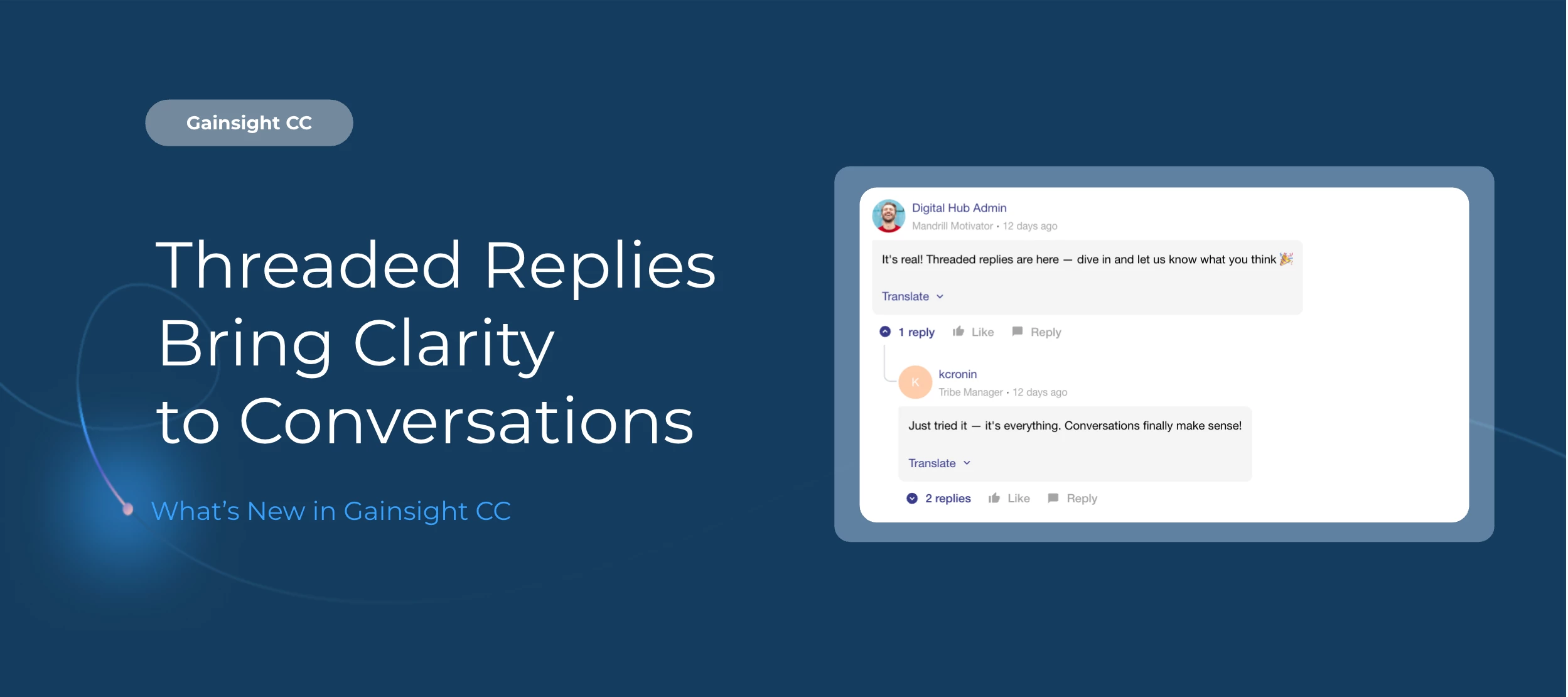
This release brings four enhancements that make community conversations easier to follow, give admins more control over moderation, who sees what, and give developers more flexibility in how they configure connectors in Developer Studio.Here's What's New Threaded RepliesTopic pages now support threaded replies, so related exchanges stay together and multi-thread discussions are easier to follow. Users can reply directly to any L1 or L2 reply, up to three levels deep. Key capabilities include: Dual reply editors that appear at the top of the thread and inline as users scroll Expandable reply input that grows as you type Paginated nested replies with a "Show more replies" option (up to 20 per page) Fixed oldest-first sort order for L2 and L3 replies The Control view has also been updated to mirror the destination view, with topic metadata and moderation controls moved to a sidebar for easier cross-referencing.Threaded Replies are optional. To enable them, turn on the toggle in Customer Communities Control.For more information, refer to the Threaded Replies article.Moderate Directly from the Topic PageAdmins can now moderate directly in the community, without switching to Control. Actions include closing a topic, marking a reply as spam, trashing a reply, highlighting a reply, and sending a Moderation Notice. For more information, refer to the Moderation article.Widget Personalization: Renamed and RefreshedThe Widget Visibility setting in Destination has been renamed to Personalization, with updated audience options that more clearly reflect how widget display works. The options are now: Everyone: Visible to all users Selected Segments: Visible to specific segment users Guest Users: Visible to users who are not signed in For more information on how to configure widget personalization, refer to the Widget Visibility article.Secrets and Variables in Developer StudioThe Secrets and Variables page under Integrations > Developer Studio now supports two distinct value types for connector configuration: Secrets store encrypted credentials such as API keys, tokens, and passwords. They are masked and restricted to headers and authentication fields. Variables store plain-text config values such as base URLs, environment IDs, and reusable settings. They stay fully visible and editable, and can be referenced anywhere a connector accepts input, including in the connector URL itself. For more information, refer to the Developer Portal documentation.Getting Started All four updates are available in your CC instance now. To enable or disable Threaded Replies, check your community settings. For Personalization settings, open any customizable page in Destination and look for the updated Personalization controls. Frontend moderation actions are available on any topic page with no configuration required. For Secrets and Variables, navigate to Integrations > Developer Studio in Customer Communities Control.👉 Check out the Release Notes for more details.💬 Have a question for our ​@Sudhanshu, ​@Larry, or ​@marekkoszlak? Drop a comment below!

Related products:CC CustomizationCC ModerationCC API
Gainsight CC: Smarter Search, Richer Insights, and a Faster Path to Answers

Gainsight CC: Smarter Search, Richer Insights, and a Faster Path to Answers

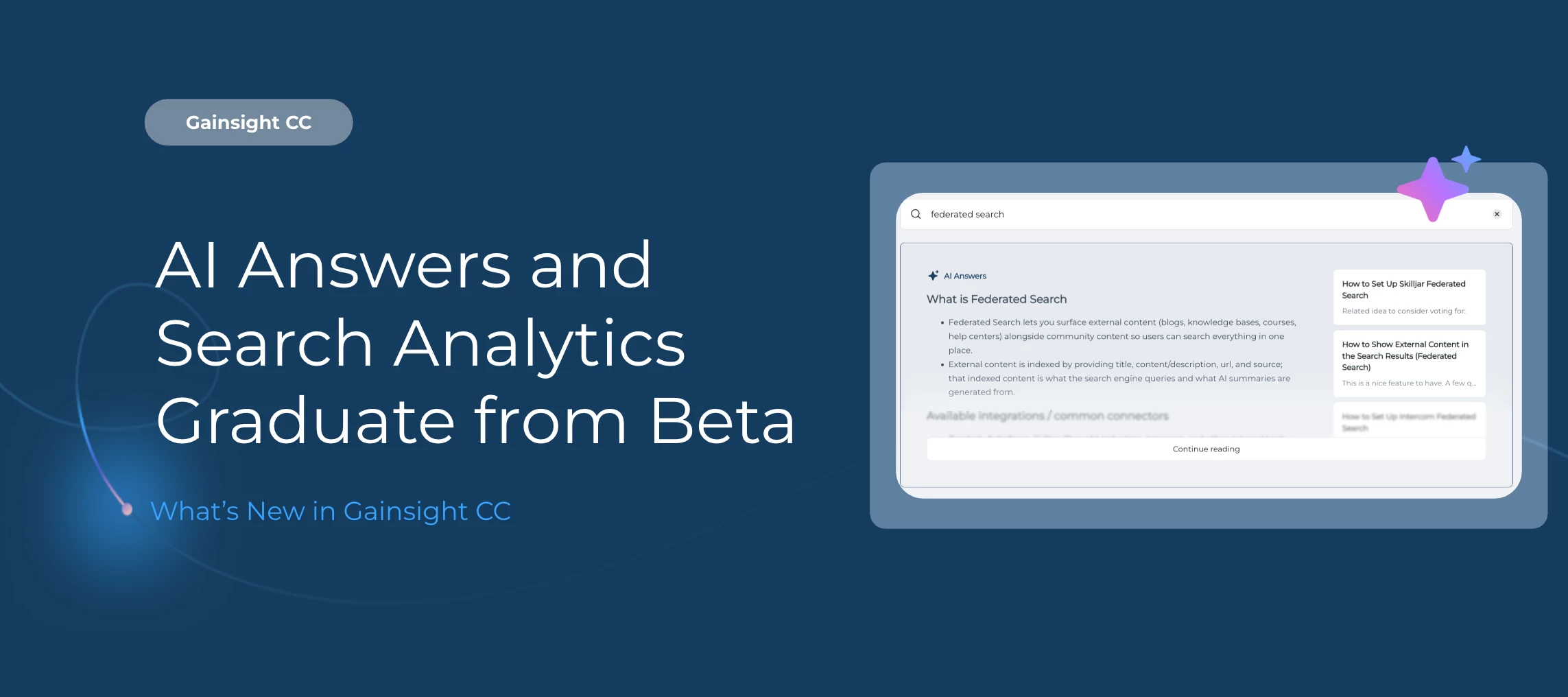
Community search just got a major upgrade. AI Answers is now generally available, the Search Analytics Dashboard is out of beta, and a new suggested questions feature makes it even easier for members to find what they need from the moment they arrive.Here's What's NewAI Answers for Search (General Availability)AI Answers is now fully live for all communities. The feature transforms community search into a real-time conversational experience, interpreting natural language queries and streaming responses as they're generated. Each answer includes source links so members can verify context or read further. Members can also expand answers with one click to see additional context and related sources.To enable it, navigate to AI > AI Answers for Search and turn on Enable AI Answers for Search.For more information, refer to the AI Answers in Customer Communities article.Search Analytics Dashboard (General Availability)The Search Analytics Dashboard is out of beta and available to all admins and community managers. Enable it from the Settings page to start tracking how members interact with search across three areas: General Search Analytics: Total users, total searches, no results rate, conversion rate, click-through rate, no clicks rate, top searches, searches without results, and top results. MCP Search Analytics: Total users, total searches, no results rate, top searches, searches without results, and top results. Available when MCP Search is enabled. AI Answers Analytics: Total summaries generated, impressions, sources clicked, continue reading clicked, show all sources clicked, and helpful/unhelpful feedback signals. Available when AI Answers is enabled. For more information, refer to the Search Analytics Dashboard article.Suggested Questions in the Search BannerYou can now add up to three suggested questions directly to the community search banner. When a member clicks one, the full-page search opens pre-filled with that query, so they spend less time typing and more time finding answers. Configure the questions in the Suggested Questions field in Destination.Getting StartedAll three features are available in your community now. AI Answers and the Search Analytics Dashboard require admin enablement. Suggested Questions are configurable in Destination without any additional settings.👉 Check out the Release Notes for more details.💬 Have questions or feedback? Drop a comment below for ​@Graeme Rycyk — or better yet, ask our new AI!

Related products:CC Analytics & ReportingCC Search
Gainsight CC: Connect Your Community and Advocacy Programs with the Champion Integration

Gainsight CC: Connect Your Community and Advocacy Programs with the Champion Integration

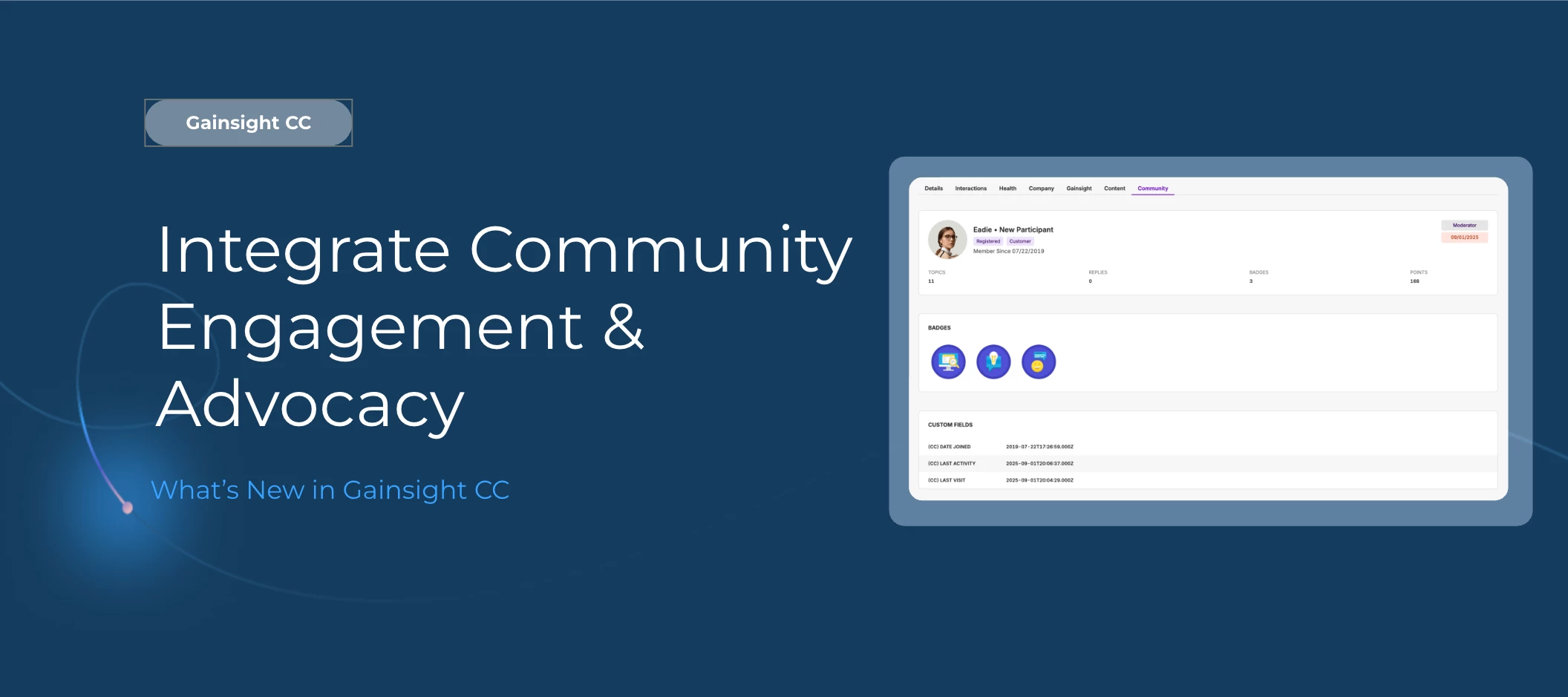
Your most engaged community members are often your best advocates. Now you can connect Gainsight Community directly to Champion, giving your team a unified view of community engagement and advocacy activity across both platforms.Here’s What’s NewPull community data into Champion profilesOnce connected, the Community tab on each Champion profile shows membership date, rank, roles, moderator status, last activity date, topic and reply counts, badges earned, and community points. Color-coded activity dates give your team an at-a-glance signal of who's active and who needs re-engagement.Community activity contributes to Champion Health ScoresReply counts, likes received, badge totals, moderator status, and last activity date all feed into the Community category of the Champion Health Score. When a member posts an article, conversation, idea, or question in Gainsight Community, Champion automatically logs it as a User Generated Content interaction, which counts toward the Advocacy category as well.Push advocate roles and portal URLs back to the communityEnable the Champion Advocate toggle to automatically assign a community role to opted-in advocates and sync each member's personalized Champion Portal URL to their community profile. The role is removed if a member's advocate status is revoked in Champion.Sync Champion interaction points to community totalsMap Champion interaction types and subtypes to your community points system. When a qualifying interaction is logged in Champion, the corresponding points are added to the member's community point balance.Automate badge awards based on advocacy milestonesDefine badge auto-assignment rules that tie community badges to real advocacy thresholds. When a Champion meets the minimum interaction count for a rule, the badge is awarded automatically in the community. Badges can also be assigned manually one at a time from a Champion profile, or in bulk from the Champion grid.Surface the Champion Portal directly in community profilesA lightweight script adds a Champion Portal link widget to an advocate's community profile sidebar, visible only to the advocate on their own profile page.How to Get StartedSetting up the integration takes two steps:Create an OAuth2 client in Gainsight Community: go to Control > Integrations > API and generate a new OAuth2 client. Copy your Client ID, Client Secret, and Region. In Champion, navigate to Settings > Integrations, find the Gainsight CC tile, and enter your credentials to connect.The initial sync may take 24 to 48 hours. Once connected, configure the Champion Advocate, Points Sync, and Badge Auto-Assignment settings from the Community settings page in Champion.Note: Badges must be tagged with "Champion Advocacy Badge" in their description to appear in Champion for assignment.👉 Check out the Release Notes for more details.💬 Have a question for our team? Drop a comment below!

Related products:CC Integrations