

Why Can’t I Find My Meeting Summary Using AI Follow-Up/Staircase?
Staircase AI: Troubleshooting Guide for Missing Meetings, Meeting Summaries and Emails
Audience: Support, CSMs and customer workspace admins Applies to: Staircase AI and AI Follow-up
1. How the integrations work (read this first)
Staircase uses two separate integration stages. Most "missing data" problems come from confusing which stage is failing.
| Stage | Purpose | Options | What it gives Staircase |
|---|---|---|---|
| 1. Calendar integration | Reads calendar events and email | Google Workspace, Microsoft (Outlook / Microsoft 365) | Emails, scheduled meetings, attendees and meeting IDs |
| 2. Meeting provider integration | Reads recordings and transcripts | Zoom, MS Teams, other supported providers | Transcripts used to generate meeting summaries |
Key rules
- Missing emails: only the calendar (mailbox) integration is needed. The meeting provider integration is not involved.
- Missing meetings (events): the calendar integration is needed. Staircase only reads meetings scheduled with stakeholders.
- Missing meeting summaries: you need both stages. The calendar supplies the event and meeting ID, and the meeting provider supplies the transcript.
2. Quick triage
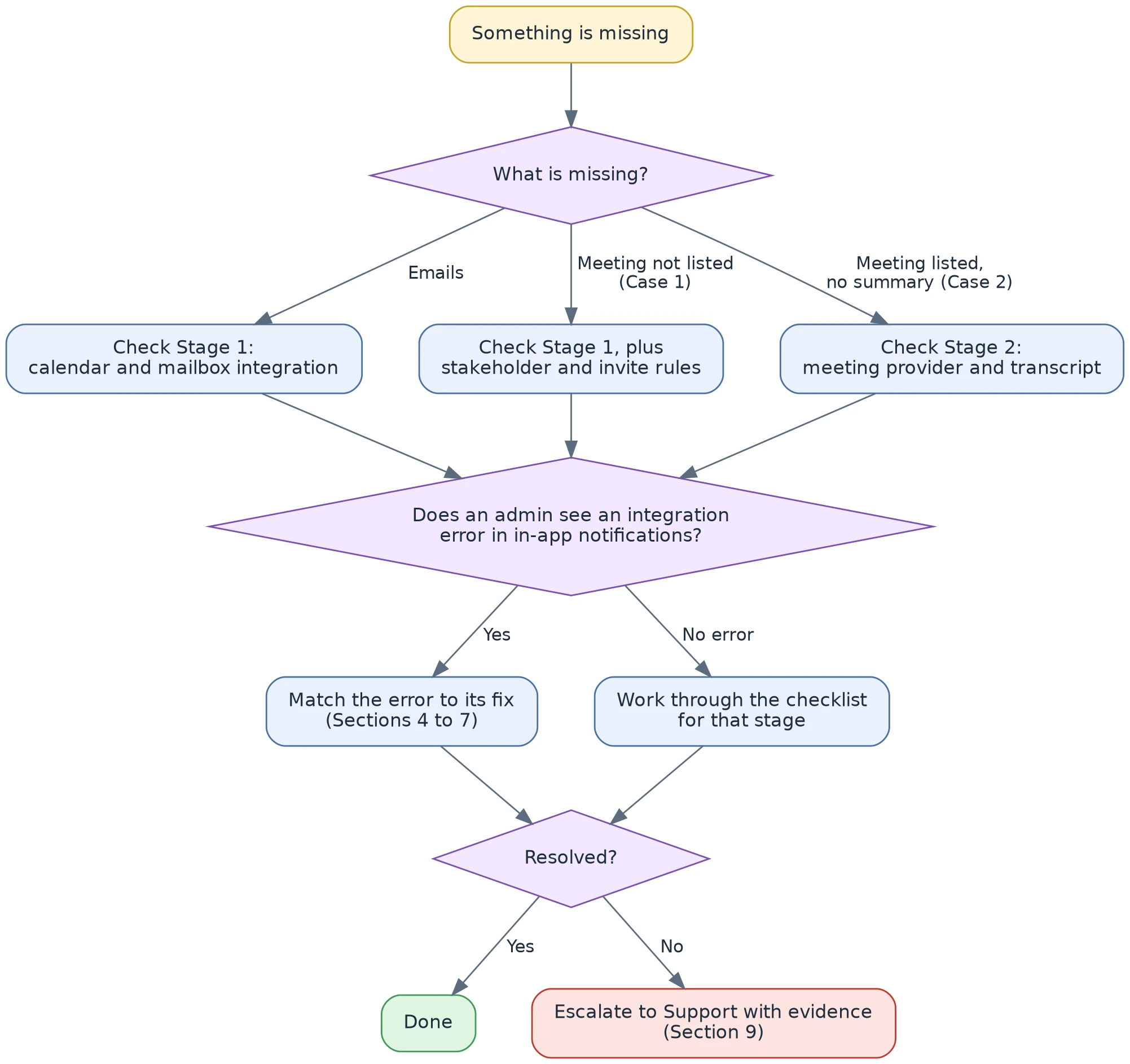
Step 0 for every case: check the error source first.
- Staircase in-app notifications. Integration failure errors are visible to admins only. If the affected user is not an admin, ask an admin to check.
- MS Teams integration page in Staircase, for MS Teams specific errors.
2A. "My meeting got missed": identify which of the two cases
When a user says a meeting is missing, it is one of two very different problems. Decide which case first, because the fixes are in different stages.
How to tell: look for the meeting in Staircase (meeting report or the account timeline).
| What you see | Case |
|---|---|
| The meeting is not listed at all | Case 1: the calendar event never arrived |
| The meeting is listed but has no summary | Case 2: the calendar event arrived, but summary generation failed |
Case 1: The calendar event never came in (invite missing)
Meaning: Staircase never received the calendar event, so there is nothing to attach a summary to. This is a Stage 1 (calendar integration) problem.
Most likely causes
| Cause | How to confirm | Fix |
|---|---|---|
| User's mailbox is not connected | The user does not show as connected in the Staircase integration page | Have the user connect, or have the admin connect the mailbox |
| Connection failure (authorization expired or revoked, permission removed, consent or policy missing) | Admin sees an integration failure in in-app notifications (admin only) | Fix the cause shown in the error (see Section 4), then disconnect and reconnect |
| Google: authorizing user lacks read access to groups and user details, or the user is not in the Staircase app group | Check the authorizing account and group membership | See 4.1 |
| Microsoft: admin consent or application policy missing, or user not in the selected group | Check consent, policy and group (see 4.2) | See 4.2 |
| Meeting has no stakeholders | The invite has no attendees who are stakeholders | Expected behavior: Staircase only reads meetings scheduled with stakeholders |
| Not created as a calendar invite | Meeting was ad hoc or the link was shared only in chat | Expected behavior: Staircase only reads meetings scheduled with a calendar invite |
Helpful detail: if the organizer's mailbox is not connected but another participant's mailbox is, Staircase can still pick up the event from that participant. So a meeting missing entirely usually means none of the participants' mailboxes delivered it.
Steps
- Confirm whether the organizer or any participant has a connected mailbox.
- Ask an admin to check in-app notifications for integration errors.
- Verify the Stage 1 requirements for Google or Microsoft (Section 4).
- Reconnect the integration after fixing the cause.
- Check that the meeting meets the invite and stakeholder rules above.
Case 2: The calendar event arrived, but the meeting summary was not generated
Meaning: Stage 1 worked (the event and meeting ID were found). The failure is in Stage 2 (meeting provider and transcript).
Work through the causes in Section 6, in this order:
- Is a transcript available? Check the provider directly. Remember that "Has Transcript" in the meeting report only means Staircase could read it, not that one exists.
- Is the organizer external? Summaries are only generated for internal meetings.
- Does the invite contain the meeting ID or link? If it was shared separately, Staircase cannot link the transcript.
- Is the meeting provider integrated? For example, Teams is connected but the meeting was on Zoom.
- Zoom: look for
Invalid_Grantin notifications and fix the authorizing user's permission (5.1). - MS Teams: verify the application access policy, license and email (5.2).
- Timing: wait at least 4 hours, and allow for the daily fallback that retries the last 3 days (Section 8).
If all of these check out, escalate with the evidence listed in Section 9.
3. Symptom to likely cause
| Symptom | Likely stage | First thing to check |
|---|---|---|
| No emails from a specific user | Stage 1 | Is that user's calendar/mailbox connected, and is the connection healthy? |
| No emails for anyone on a Microsoft tenant | Stage 1 (Microsoft) | Admin consent, application policy, and which app is connected (see 4.2) |
| No emails for anyone on Google | Stage 1 (Google) | Permissions of the authorizing user (see 4.1) |
| Meeting missing from Staircase | Stage 1 | Calendar connected? Meeting scheduled with a calendar invite and with stakeholders? |
| Meeting present, no summary, MS Teams | Stage 2 (Teams) | Application access policy assignment (see 5.2) |
| Meeting present, no summary, Zoom | Stage 2 (Zoom) | Invalid_Grant error and the authorizing user's Zoom permissions (see 5.1) |
| Meeting present, no summary, other provider | Stage 2 | Is that provider integrated in the workspace at all? |
| Summary delayed | Timing | Allow 2 to 4 hours, see Section 8 |
4. Stage 1: Calendar integration (Google and Microsoft)
For email ingestion, a healthy calendar integration is enough.
4.1 Google Workspace
Requirements
- The person who authorizes the connection must have read access to user groups and user details in Google Workspace.
- Each user whose data should be read must exist in the group assigned to the Staircase app in Google Workspace.
Checklist
- Confirm who authorized the Google connection, then check that account's Workspace permissions (user groups and user details read access).
- Confirm the affected user is a member of the Google Workspace group assigned to the Staircase app.
- Check Staircase in-app notifications (admin) for integration failure errors.
- If permissions or group membership were changed, disconnect and reconnect the integration in Staircase.
Common causes
| Cause | Fix |
|---|---|
| Authorizing user lacks read access to groups and user details | Have a Workspace admin with sufficient rights re-authorize |
| Affected user not in the assigned Staircase group | Add the user to the group, then allow time to sync |
| Authorizing user left the company or was deactivated | Re-authorize with an active admin account |
4.2 Microsoft (Outlook / Microsoft 365)
Requirements
- A policy must be created in Microsoft (application access policy) for the Staircase app.
- A Microsoft workspace admin must enable (consent to) the connection.
- During setup an admin selects a group on the Staircase Microsoft integration page. It is highly recommended to use the same group ID when creating the application policies for MS Teams.
Two apps appear in Azure AD / Entra after connecting Outlook and MS Teams
| App | Purpose | App ID (verify with IT) |
|---|---|---|
| Staircase AI (or Gainsight App for Calendar for AI Follow-up customers) | Calendar, and email for Staircase AI | Starts with 504f82fe-… |
| Staircase AI for Teams | MS Teams meeting transcripts | Starts with 4707327f-… |
Important differences
- Staircase AI app reads both emails and meetings.
- Gainsight App for Calendar (AI Follow-up customers) reads calendar events only and does not read emails. If an AI Follow-up customer expects emails, this is expected behavior, not a fault.
- Always have the customer's IT admin verify the App IDs match the ones shown on the Staircase Microsoft integration page.
- Staircase can read Teams transcripts only if the user is assigned access to both apps.
Checklist
- Confirm a workspace admin has granted consent to the connection.
- Confirm the application access policy exists and is assigned (see commands in Section 5.2).
- Confirm the affected user belongs to the group chosen during setup.
- Check in-app notifications (admin) for the exact error text.
- After any policy change, disconnect and reconnect the user's integration.
5. Stage 2: Meeting provider integration
A meeting summary needs a transcript. Staircase reads it from the meeting provider using the meeting ID found in the calendar event.
5.1 Zoom
Symptom: The meeting appears, but the summary does not generate. In notifications you see an Invalid_Grant error.
Cause: The user who authorized the Zoom connection does not have permission to read teammates' meetings.
Fix
- Ask the customer's Zoom admin to grant the authorizing user access to read all teammates' meetings (at minimum, transcripts for all users with a connected mailbox).
- Disconnect and reconnect the Zoom integration in Staircase.
5.2 Microsoft Teams
MS Teams has the most setup requirements. Errors are shown on the MS Teams integration page in Staircase.
Requirements
- The meeting organizer must be assigned the correct Teams application access policy.
- The user must have a valid Teams license.
- The user's email must be recognized by MS Teams.
Common error messages
| Error | Meaning |
|---|---|
| The application access policy is not assigned to the user | The Teams policy was not created or not granted to this user (or their group) |
| The email could not be found in MS Teams | Teams does not recognize that email (wrong address or alias, or no Teams presence) |
Validation steps for the customer's IT admin (PowerShell)
| # | Check | Command |
|---|---|---|
| 1 | Mailbox connected to the Staircase calendar app (use the Staircase Entra App ID from the Microsoft Integration page) | Test-ApplicationAccessPolicy -AppId "<Staircase_Entra_App_ID>" -Identity "<email_address_to_test>" |
| 2 | User has a Teams license | Get-MgUserLicenseDetail -UserId 'user@example.com' | Format-List |
| 3 | Application access policy granted to the user | Get-CsUserPolicyAssignment -Identity "<user@email.com>" -PolicyType ApplicationAccessPolicy |
| 4 | If assigned by group, policy attached to the right group | Get-CsGroupPolicyAssignment -GroupId "<YOUR_GROUP_ID>" -PolicyType ApplicationAccessPolicy |
| 5 | Policy points to the correct Teams application ID | Get-CsApplicationAccessPolicy -Identity "<MS_Teams_Application_policy>" |
A simpler check for a single user: Get-CsUserPolicyAssignment -Identity "user@email.com".
If assignments are missing or inconsistent, the admin must assign the correct policy for both Staircase apps.
5.3 Other integrations (non-Teams)
For any other provider, there is no separate policy to configure in most cases. Check Staircase in-app notifications (admin only) for the failure reason, then fix the permission or authorization indicated and reconnect.
6. Why a meeting summary may not appear (rules and edge cases)
| # | Cause | What to check or do |
|---|---|---|
| 1 | No transcript available | The meeting was created manually, the meeting ID does not match the transcript, or the meeting did not happen at the scheduled time. Confirm in the provider that a transcript exists. |
| 2 | Meeting organized by an external stakeholder | Summaries are only generated for internal meetings. External organizers are not summarized. |
| 3 | Meeting ID missing from the calendar invite | If the link was shared by chat and not in the invite, the transcript cannot be linked. The organizer should put the meeting link in the invite. |
| 4 | Zoom permission issue (Invalid_Grant) | See 5.1. |
| 5 | MS Teams application policy not assigned | See 5.2. |
| 6 | Provider not integrated | For example, Teams is integrated but the user hosts on Zoom. No transcript can be fetched. |
| 7 | Meeting not scheduled via calendar invite | Staircase only reads meetings created through a calendar invite. Ad hoc meetings and recordings without proper details are ignored. |
| 8 | Organizer's calendar not connected | If another participant's calendar is connected, Staircase can still find the event, but summaries depend on provider rules. Example: with Zoom, if the authorized user can read all meetings, it works. With MS Teams, transcripts cannot be read if the organizer's mailbox is not connected. |
Note on the "Has Transcript" status: In the meeting report this means Staircase was able to read the transcript. It does not confirm that a transcript actually exists in Zoom, Teams or another provider. Always verify in the provider.
7. Where to find the error
| Where | Who can see it | What it shows |
|---|---|---|
| Staircase in-app notifications | Admins only | Integration failures such as Invalid_Grant and permission errors |
| MS Teams integration page | Admins | MS Teams specific errors (policy not assigned, email not found) |
| Meeting report | Users | Meeting status and the "Has Transcript" flag |
If a non-admin user reports a problem, an admin should check notifications first. Non-admins cannot see these errors.
8. Timing expectations (avoid false alarms)
- Transcript delivery from the provider can take roughly 30 to 90 minutes.
- Summaries are normally generated within 2 to 4 hours after the meeting.
- If generation fails or times out, a daily fallback job re-fetches failed summaries from the last 3 days.
- In special cases, Engineering can run a manual meeting summary sync.
- Staircase depends on the provider delivering the transcript, so summaries are not instant the way bot-based recorders can be. Set this expectation with customers before escalating.
Rule of thumb: do not escalate a missing summary until at least 4 hours have passed, and ideally until the next daily fallback run has happened.
9. Escalation: when and what to send to Support
Escalate only after completing the checks for the relevant stage.
Always include
- Workspace name and the affected user's email
- Calendar type (Google or Microsoft) and meeting provider (Zoom, Teams, other)
- The exact error message from in-app notifications or the Teams integration page
- Date and time of the missing meeting, and whether it is one meeting or all meetings
For missing meeting summaries
- Screenshot of the calendar invite from the organizer's calendar, showing participants, date, time and meeting details
- Screenshot confirming the transcript exists in the meeting provider
For Microsoft Teams issues
- Screenshots of the PowerShell outputs from Section 5.2 for the affected user, covering both Staircase apps
For Google issues
- Confirmation of who authorized the connection and their Workspace permissions
- Confirmation that the affected user is in the assigned Staircase group